


Wondering what food never expires and which pantry staples can last for years? From honey, salt and sugar to white rice, dried beans and lentils, some foods have an exceptionally long shelf life. Learn which foods last the longest, why they stay usable, and how to store them properly at home.
If you are wondering what food never expires, the answer is more interesting than you might expect. Honey, salt, sugar and some other shelf-stable foods can remain usable for an extremely long time when stored correctly. However, “never expires” does not mean every food stays perfect forever. Storage conditions, packaging and food quality all matter.
What Does “Never Expires” Actually Mean?
The phrase what food never expires can be confusing because food labels do not all mean the same thing. Some foods can remain safe for a very long time, while others may technically still be usable but lose their taste, texture or nutritional quality.
For example, honey is famous for its exceptionally long shelf life. Salt and sugar can also last for an extremely long time when kept dry and protected from contamination.
However, many other foods that people call “non-expiring” are better described as long-lasting foods. Dried beans, white rice and some other pantry staples can stay usable for years under suitable storage conditions, but they are not necessarily permanent.
This difference is important when building a pantry or simply trying to reduce food waste.
A useful way to think about long-lasting food is to ask three questions:
Can the food remain safe for a very long time?
Can it retain good quality for a very long time?
Does it need special storage to achieve that shelf life?
The answer can be different for every food.
Which Foods Can Last Almost Forever?
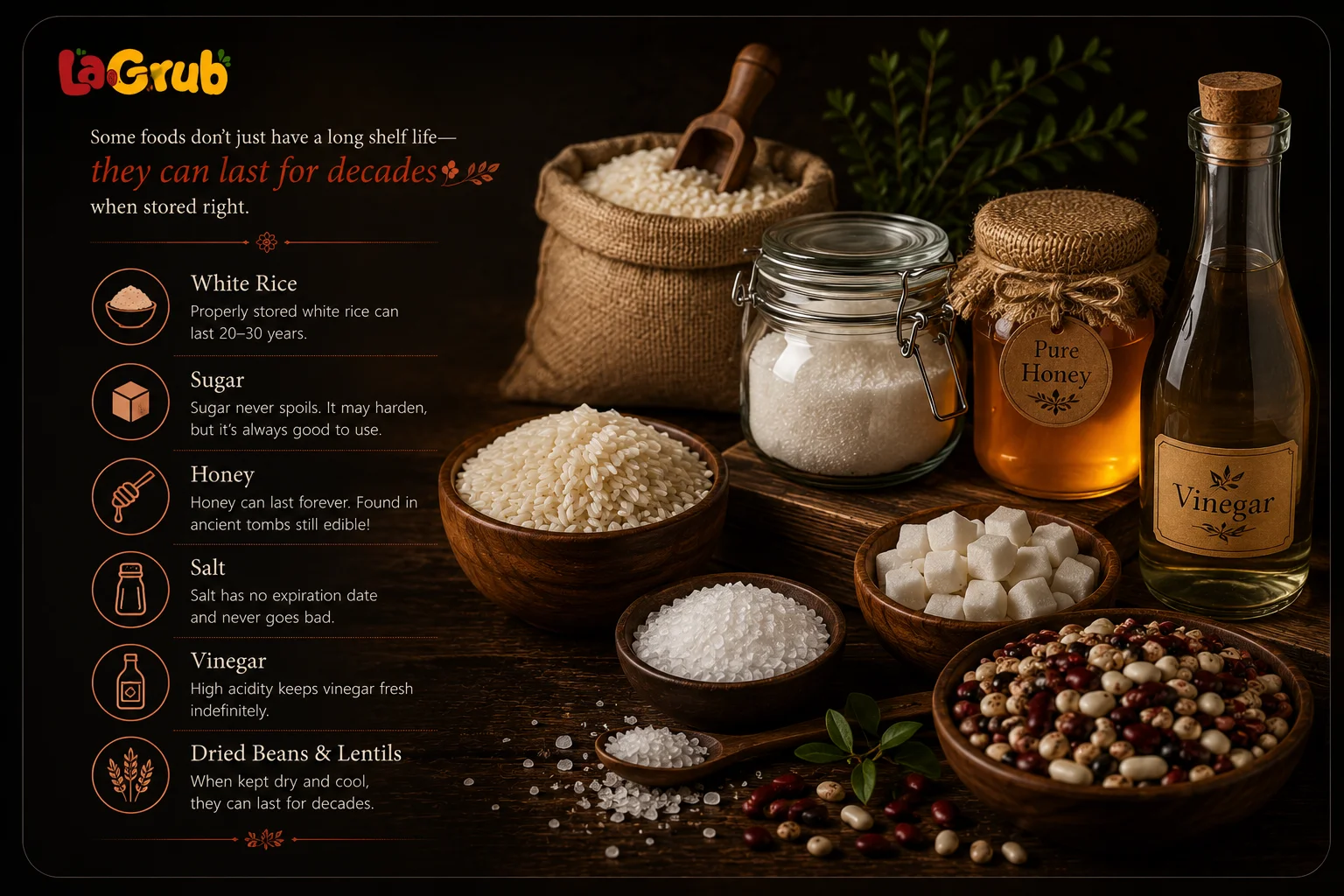
Some foods are well known for their exceptional shelf life. Their natural properties make it difficult for bacteria and other microorganisms to grow when the food is stored correctly.
Honey
Honey is one of the best-known examples when discussing what food never expires.
Pure honey has very little available water and is naturally acidic. These properties make it difficult for many microorganisms to grow.
Over time, honey may become darker, thicker or crystallised. However, crystallisation does not automatically mean that honey has gone bad. The texture can change while the honey remains usable.
If your honey crystallises, gentle warming can help return it to a smoother consistency.
The most important storage rule is to keep honey in a clean, tightly closed container. Avoid introducing water or food particles into the jar.
So, when people ask which food can last for generations, honey is usually near the top of the list.
Salt
Salt is another classic long-lasting food.
Pure salt is a mineral rather than a food that easily supports microbial growth. When kept dry and clean, it can remain usable for an extremely long time.
The main problem with salt is usually moisture. Salt can become hard or form lumps when exposed to humidity.
That does not necessarily mean the salt has spoiled. It may simply have absorbed moisture.
Keep salt in an airtight container in a dry cupboard to maintain its quality.
Sugar
Granulated white sugar can also last for a very long time when stored properly.
Sugar has very little available water, which makes it difficult for many microorganisms to grow.
However, sugar can absorb moisture and develop lumps. It can also pick up smells from strongly scented foods if it is not stored in a sealed container.
Therefore, keeping sugar dry and tightly covered is the key to long-term storage.
Brown sugar is different. Because it contains more moisture, it can harden over time and generally does not behave exactly like white sugar.
Can Rice Last Forever?
Rice is often included in lists of foods that last for years, but the type of rice matters.
White rice can have a long shelf life because it contains less natural oil than brown rice.
Brown rice contains more of the grain's natural oils. These oils can become rancid over time, especially when the rice is exposed to heat, light or oxygen.
This is why white rice is usually a better choice for long-term pantry storage.
For the best results, keep rice in a cool, dry place in an airtight container.
If you are storing rice for a long period, protecting it from moisture, insects and heat is just as important as choosing the right variety.
So, although rice is a long-lasting pantry food, it is more accurate to say that some varieties last much longer than others rather than claiming that rice never expires.
Do Dried Beans Ever Expire?
Dried beans are another food people often ask about when searching for what food never expires.
Dry beans contain very little moisture, which helps them last much longer than fresh beans.
Properly stored dried beans can remain usable for years. However, their quality may slowly change.
Older beans may take longer to cook and may not become as soft as fresher beans.
This means that dried beans can be excellent for long-term pantry storage, but they should not automatically be treated as an “eternal” food.
Keep them dry, cool and protected from insects.
What About Lentils?
Lentils are another useful pantry staple.
Like dried beans, they have low moisture and can last for a long time when stored properly.
Different types of lentils may vary slightly in storage life, but the basic rule remains the same: protect them from moisture, heat, pests and contamination.
Older lentils may take longer to cook, but that does not necessarily mean they are spoiled.
A clean, dry and sealed container can help maintain their quality for much longer.
Does Pasta Expire?
Dry pasta can last for a long time, especially when it is kept unopened or stored correctly after opening.
Plain dried pasta has very little moisture, so it is much more shelf-stable than fresh pasta.
However, pasta should still be checked before cooking. If you notice insects, unusual odours, moisture damage or signs of mould, it should not be used.
Pasta is therefore better described as a long shelf-life food rather than food that never expires.
Can Flour Last Forever?
Flour is not usually considered a forever food.
White flour can last for a considerable amount of time when stored properly, but it can eventually lose quality.
Wholegrain flours generally have a shorter shelf life because they contain more natural oils from the grain.
Heat and oxygen can speed up deterioration.
If you want to store flour for longer, keep it in a tightly sealed container in a cool, dry place.
Always check for unusual smells, insects, moisture or mould before using older flour.
Which Foods Last the Longest?
When comparing foods that never expire with foods that last for many years, it helps to separate them into categories.
Foods such as pure honey, salt and sugar can remain usable for extremely long periods when stored correctly.
Other dry foods can last for years but gradually lose quality.
These include:
White rice
Dried beans
Lentils
Dry pasta
Some grains
Powdered foods
Certain dried vegetables
The important point is that shelf life depends on more than the food itself.
Packaging, temperature, moisture and cleanliness can make a major difference.
Why Do Some Foods Last So Long?
The science behind what food never expires is actually quite simple.
Microorganisms such as bacteria, mould and yeast need suitable conditions to grow. Water availability is one of the most important factors.
Foods that contain very little available water are generally more resistant to microbial growth.
Sugar and salt work in part because they bind available water. Honey also has properties that make it difficult for many microorganisms to survive.
Acidity can also help. Foods with a low pH are less suitable for many harmful microorganisms.
This is why preservation methods such as drying, salting, sugaring and pickling have been used for generations.
However, low moisture does not make every food completely immune to deterioration. Fats can become rancid, and food can still be damaged by heat, oxygen, pests or moisture.
Does “Best Before” Mean the Food Has Expired?
Not necessarily.
A best-before date is generally connected with quality. After that date, a product may not taste or perform exactly as it did when fresh.
An expiry or use-by date can have a different meaning, particularly for foods that can become unsafe.
This is why you should not treat every date printed on a food package as proof that the food is immediately unsafe afterwards.
Instead, consider the type of food, storage conditions and the manufacturer's instructions.
For foods with a safety-based use-by date, do not ignore the date simply because the food looks or smells normal.
How to Store Food for the Longest Time
Knowing what food never expires is only half the answer. Storage is equally important.
The basic rule is simple: keep long-lasting foods dry, cool, clean and protected from air and pests.
Keep Food Dry
Moisture is one of the biggest enemies of dry pantry foods.
Water can encourage mould growth and can cause dry foods to clump or deteriorate.
Use sealed containers and keep them away from areas where steam or water can enter.
Store Food in a Cool Place
Heat can speed up deterioration.
A pantry away from direct sunlight and heat-producing appliances is usually a better location than a hot kitchen shelf.
Use Airtight Containers
Airtight containers help protect food from humidity, insects and strong smells.
Glass jars, food-safe plastic containers and suitable storage containers can all work well when properly cleaned and sealed.
Keep Food Away From Light
Light can affect the quality of certain foods, especially products containing fats.
A dark cupboard or opaque container can offer better protection.
Rotate Your Pantry
Even foods with a very long shelf life should not simply be forgotten.
Use older products first and replace them with newer ones.
This is known as the “first in, first out” approach.
It helps reduce waste and keeps your pantry organised.
Foods That People Think Never Expire But Do
There are several foods that are often described as immortal or permanent, but the reality is more complicated.
Cooking Oil
Cooking oil does not last forever.
Oil can become rancid when exposed to oxygen, heat and light. Some oils last longer than others, but they still need proper storage.
Nuts
Nuts contain natural oils, which can eventually become rancid.
Keeping them cool can help slow this process, but they should not be treated as forever foods.
Wholegrain Flour
Wholegrain flour contains more natural oils than refined flour. As a result, it generally has a shorter storage life.
Brown Rice
Brown rice can spoil more quickly than white rice because of its natural oil content.
Dried Fruit
Dried fruit has less water than fresh fruit, but it still contains enough moisture and sugar to change over time.
It may become harder, darker or develop unwanted mould if stored poorly.
What Food Is Best for a Long-Term Pantry?
If your goal is to build a practical pantry, focus on foods that are both nutritious and easy to store.
A good long-term pantry might include rice, dried beans, lentils, pasta, oats, sugar, salt, honey and other suitable dry foods.
However, long-term storage should not focus only on shelf life.
You also need variety.
A pantry full of one food may last for years but still provide a poor range of nutrients.
Try to balance long-lasting staples with foods that provide protein, carbohydrates, fats and other nutrients.
This makes your food supply more useful for everyday cooking.
How to Tell If Long-Lasting Food Has Gone Bad
Even when a food has a long shelf life, you should inspect it before eating.
Look for signs such as:
Mould
Unusual smells
Insect activity
Moisture damage
Strange colours
Swollen or damaged packaging
Signs of contamination
Do not taste a questionable food to find out whether it is safe.
When in doubt, it is safer to discard it.
This is particularly important for foods that have been exposed to water, pests or unsuitable temperatures.
Does Freezing Make Food Last Forever?
Freezing can dramatically extend the life of many foods, but it does not make them last forever.
Food stored in a freezer can still lose quality over time. Freezer burn, changes in texture and flavour loss can occur.
Freezing also does not repair food that was already spoiled before it went into the freezer.
For the best results, freeze food while it is still fresh and use suitable airtight packaging.
What Are the Best Foods for Emergency Storage?
If you are preparing a pantry for emergencies, choose foods that are shelf-stable, practical and familiar.
Dry foods can be useful because they take up relatively little space and can remain usable for a long time.
Rice, lentils, dried beans, oats, pasta, sugar, salt and honey are examples of foods that can form part of a long-term pantry.
However, remember that some dry foods require water and cooking before they can be eaten.
So, emergency food planning should consider more than shelf life. You should also think about access to clean water, cooking equipment, storage space and a balanced diet.
How Long Does Honey Really Last?
Honey deserves special attention because it is one of the closest examples of a food that can remain usable indefinitely under suitable conditions.
It may crystallise, darken or become thicker over time.
These changes do not automatically mean the honey has spoiled.
The biggest risks are moisture and contamination. Always use clean utensils and keep the container tightly closed.
If water gets into the honey, its storage properties can change and fermentation may become possible.
So, while honey is famous for its extremely long shelf life, good storage is still essential.
How Salt and Sugar Should Be Stored
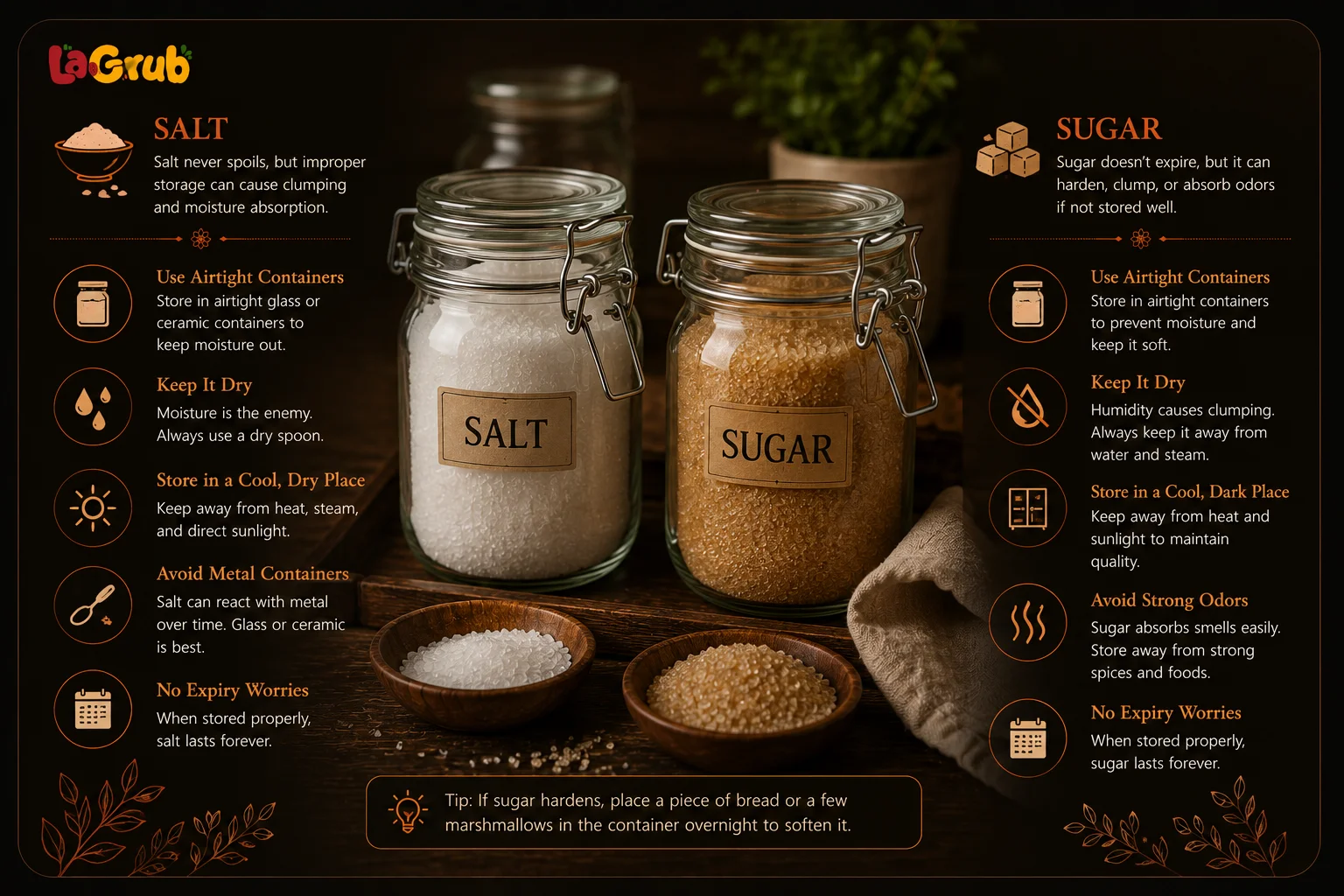
Salt and sugar are simple to store, but moisture control is important.
Keep both in sealed containers.
Do not store them beside a kettle, sink or other source of steam.
Sugar may form hard lumps when it absorbs moisture. Salt may also become clumpy.
Clumping does not automatically mean spoilage. In many cases, it simply means the product has absorbed moisture.
Keeping your pantry dry helps prevent this problem.
How to Reduce Food Waste With Long-Lasting Foods
Understanding what food never expires can also help reduce waste.
Long-lasting pantry staples allow you to keep useful ingredients available without needing to replace them frequently.
However, buying large amounts only makes sense if you will actually use them.
A better approach is to buy foods your household already enjoys.
For example, if you regularly cook rice and lentils, keeping a sensible supply can make meal planning easier.
You can then rotate your stock rather than letting it sit unused for years.
This approach saves money and makes your pantry more practical.
Frequently Asked Questions
What food never expires?
Pure honey, salt and sugar are among the best-known foods that can remain usable for an extremely long time when stored properly. However, “never expires” should not be taken to mean that every food remains unchanged forever.
Does rice ever expire?
Rice can have a long shelf life, especially white rice. However, it can eventually lose quality, become infested or be affected by moisture. Brown rice generally has a shorter shelf life because it contains more natural oils.
Can dried beans last for years?
Yes. Properly stored dried beans can remain usable for years. Older beans may take longer to cook or may not soften as easily, so long storage can affect quality even when the beans remain usable.
Why does honey last so long?
Honey has low available water and natural acidity, creating conditions that make it difficult for many microorganisms to grow. Properly stored honey can remain usable for an exceptionally long time.
What food is best for long-term storage?
Dry staples such as white rice, dried beans, lentils, pasta, oats, salt, sugar and honey can be useful for long-term pantry storage. Choose foods you actually eat and store them in cool, dry and sealed conditions.
Conclusion
If you have been searching for what food never expires, honey, salt and sugar are among the strongest examples of foods that can remain usable for an exceptionally long time. However, most pantry foods are better described as long-lasting rather than truly permanent.
White rice, dried beans, lentils and pasta can all be useful for long-term storage, while foods containing natural oils, such as nuts and brown rice, generally need more care.
The biggest lesson is simple: good storage matters. Keep food dry, cool, clean and protected from pests and moisture. Check older products before using them, and never rely on the idea that a food is automatically safe just because it is considered “non-expiring”.
For more practical food guides, cooking ideas and pantry-friendly recipes, explore LaGrub and discover more ways to make the most of the ingredients you already have.

Maimoona Ehtisham
Maimoona Ehtisham writes for LaGrub on cooking, recipes, and mindful culinary living.
Get a desi recipe worth cooking, every week
One tested recipe a week. Nothing else, and unsubscribe any time.


