

Wondering how to meal prep salads without ending up with soggy lettuce or watery vegetables? The key is to control moisture, store dressing separately, dry your greens properly, and protect crunchy toppings. With simple preparation and smart layering, you can keep your meal-prepped salads fresh, crisp, and ready for busy days.
Wondering how to meal prep salads without ending up with soggy lettuce by the middle of the week? The secret is controlling moisture, choosing ingredients that store well, and keeping dressing away from delicate greens. With the right preparation and storage method, you can enjoy crisp, convenient salads throughout your busy week.
Why Meal Prep Salads?
Salads are easy to customise, which makes them useful for weekly meal prep. You can prepare vegetables, leafy greens, protein, toppings, and dressing ahead, then combine them when you are ready to eat.
The problem is that salads contain ingredients with very different textures.
Lettuce needs to stay dry and crisp. Tomatoes and cucumbers contain lots of water. Dressing adds even more moisture. Croutons and other crunchy toppings quickly become soft when they touch wet ingredients.
That is why successful salad meal prep is less about putting everything into one container and more about deciding what should stay together and what should remain separate.
Once you understand this, preparing salads ahead becomes much easier.
How to Meal Prep Salads for Beginners
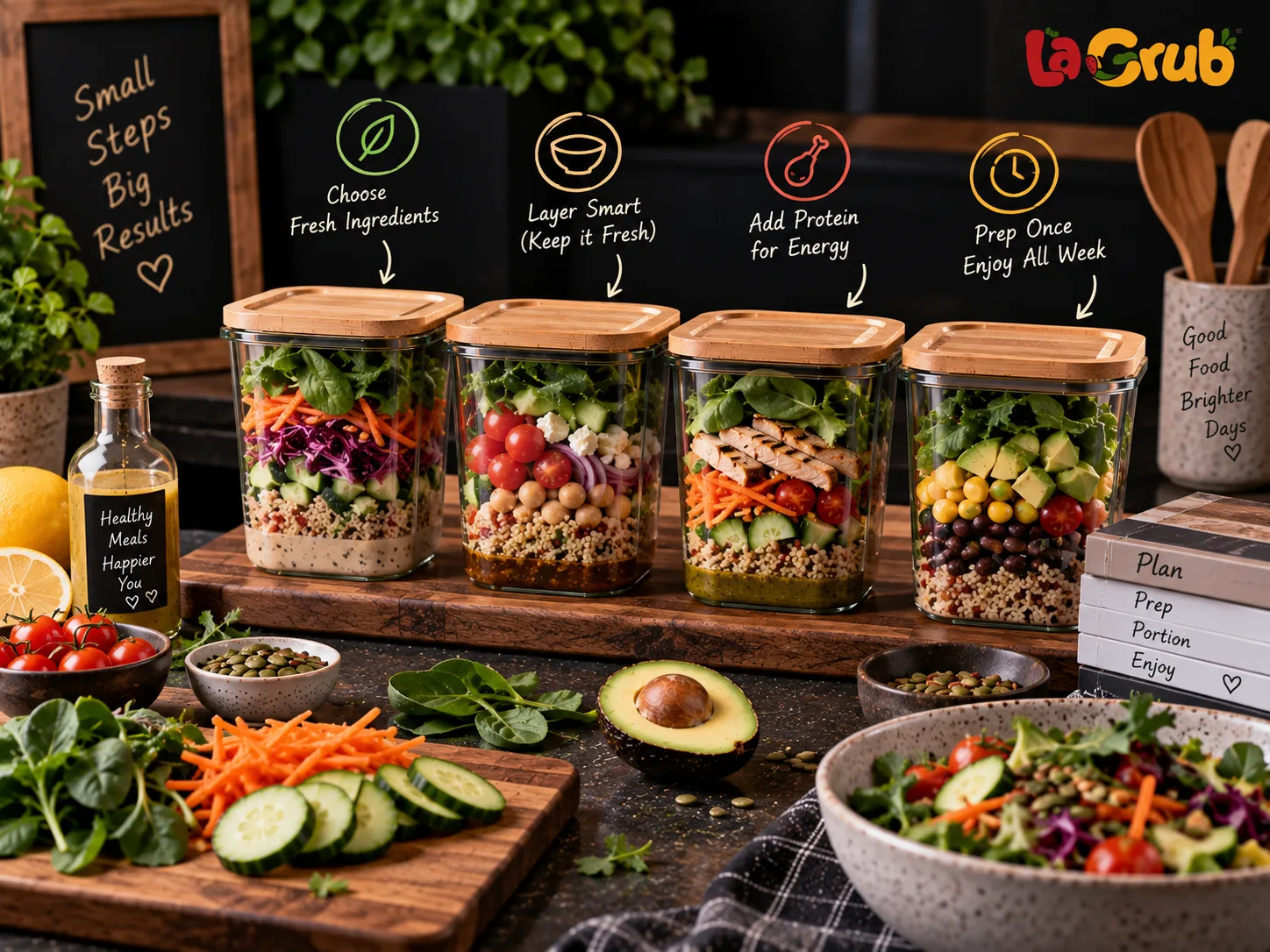
If you are new to meal prepping salads, do not start by preparing seven complicated salads.
Begin with three or four portions.
Choose one leafy base, two or three vegetables, a protein, one dressing, and a crunchy topping. Prepare each ingredient correctly and then either portion everything into containers or store the ingredients separately.
A simple salad might include:
Romaine lettuce
Carrots
Bell peppers
Chickpeas or cooked chicken
Cheese
Seeds
Your favourite dressing
Keep ingredients that release lots of moisture separate when necessary.
Once you know how well your ingredients hold up, you can prepare larger batches and experiment with more combinations.
For inspiration, browse the LaGrub recipe collection and look for proteins, vegetables, grains, and other ingredients that can become part of your weekly salads.
Choose Ingredients That Stay Fresh
Your salad will only stay as fresh as the ingredients inside it.
Firm vegetables tend to be easier to prepare ahead because they keep their structure better. Carrots, cabbage, radishes, bell peppers, and similar vegetables can be useful choices.
Leafy greens require more care.
Romaine, cabbage, kale, spinach, and mixed leaves all behave differently after washing and storing. Delicate leaves may wilt sooner, while sturdy greens can often handle meal preparation better.
You should also consider moisture.
A dry carrot does not affect lettuce in the same way as sliced tomato covered in juice. Therefore, do not assume every vegetable should be chopped and mixed together on prep day.
Choosing ingredients strategically is one of the easiest ways to improve meal prep salad freshness.
Wash and Dry Your Greens Properly
One of the most important steps in learning how to meal prep salads is drying your greens.
Washing lettuce ahead can save time, but storing wet lettuce is a common reason prepared salads lose their texture.
Wash your greens thoroughly, then remove as much surface water as possible.
A salad spinner makes this easy. If you do not own one, gently pat the leaves dry with a clean kitchen towel or paper towel.
Give the leaves enough time to dry before placing them into containers.
This small step makes a big difference.
When water remains trapped between lettuce leaves, the salad can become wet and limp much faster. Starting with clean, dry greens gives you a much better base for several days of meals.
How to Keep Meal Prep Salads From Getting Soggy
Sogginess is probably the biggest problem with salad meal prep.
Fortunately, most soggy salads have the same cause: too much moisture reaching ingredients that should remain dry.
The first rule is simple.
Keep wet ingredients away from leafy greens for as long as possible.
Do not pour dressing over five salads on Sunday and expect the lettuce to remain crisp for several days.
Be careful with juicy vegetables as well.
Tomatoes, cucumbers, pickled ingredients, sauces, and some cooked vegetables can release liquid into the container.
You can reduce the problem by storing wetter ingredients separately or layering the salad carefully.
Crunchy ingredients need protection too.
Croutons, tortilla strips, crackers, and similar toppings should normally be kept dry until you are ready to eat.
The goal is not to remove moisture from every ingredient. It is to control where that moisture goes.
Should You Put Paper Towel With Meal Prep Salad?
A clean paper towel can help manage extra moisture around leafy greens.
After washing and thoroughly drying the leaves, place them in a clean container. A dry paper towel can be placed with the greens to help absorb condensation and small amounts of excess moisture.
If the towel becomes very damp, replace it.
However, this trick does not replace proper preparation.
Putting soaking-wet lettuce into a container with a paper towel will not solve the problem. The greens should still be properly dried first.
Think of the paper towel as an extra moisture-control step rather than the main method of keeping lettuce fresh.
What to Do With Tomatoes and Cucumbers
Tomatoes and cucumbers taste great in salads, but both can create problems during weekly salad prep because they contain plenty of water.
Once cut, they can release liquid into the container.
That liquid may eventually reach your lettuce, cheese, croutons, or other ingredients.
One option is to keep sliced cucumber and tomato in separate small containers and add them just before eating.
Whole cherry or grape tomatoes can also be convenient because leaving them whole reduces the amount of exposed juicy flesh.
If you prefer putting everything together, place wetter vegetables away from delicate greens and avoid leaving them directly on top of the lettuce.
A little extra organisation during preparation can prevent a watery lunch later.
Should Salad Dressing Be Stored Separately?
For most traditional meal prep salads, storing the dressing separately is one of the easiest ways to protect texture.
Dressing is designed to coat ingredients. That is great when you are about to eat your salad, but not when dressed lettuce needs to sit for several days.
Use a small dressing container and pour it over the salad just before eating.
There is one useful exception.
If you are preparing a properly layered mason jar salad, dressing can go at the bottom of the jar. Firm ingredients then create a barrier between the dressing and leafy greens.
The main rule remains the same: delicate leaves should not sit in dressing for days.
How to Layer Meal Prep Salads
Layering can help if you want complete grab-and-go salads rather than several separate containers.
Start with ingredients that can handle moisture.
For a jar-style salad, you might arrange ingredients like this:
Dressing at the bottom
Chickpeas, beans, or other sturdy ingredients
Firm vegetables such as carrots and peppers
Grains or suitable protein
Cheese or other toppings
Leafy greens near the top
The exact order can change depending on your recipe.
The principle is more important than following one rigid formula.
Wet and heavy ingredients stay low. Dry and delicate ingredients stay high.
When you are ready to eat, combine everything so the dressing coats the salad.
How to Make Mason Jar Salads
Mason jar salads are popular because they use vertical space to separate ingredients.
Start with a clean, dry jar.
Add dressing first if you want it stored in the same container. Follow with sturdy ingredients that will not suffer from sitting close to dressing.
Add firmer vegetables and protein next.
Keep lettuce and other delicate greens towards the top where they remain away from most moisture.
Leave enough room to move the ingredients when serving.
You can shake the jar before transferring the salad to a bowl or combine it according to your preferred method.
Mason jars are useful, but they are not essential. The same layering idea works in many well-sealed meal-prep containers.
Individual Salads or Separate Ingredients?
There are two excellent ways to approach how to meal prep salads, and neither is right for everyone.
Individual containers are ideal for convenience.
You can grab one from the fridge before work or university without building lunch each morning.
Ingredient preparation offers more flexibility.
Instead of making five identical salads, prepare containers of washed greens, chopped vegetables, proteins, toppings, and dressings.
Then build a different combination each day.
This method can also help delicate ingredients stay fresh because everything is not sitting together.
A third option is a mixture of both.
Prepare the dry salad base in individual containers while keeping dressing, juicy vegetables, and crunchy toppings separate.
Choose the system that fits your routine rather than copying someone else's meal-prep setup.
How to Add Protein to Meal Prep Salads
Adding protein can turn a light side salad into a more satisfying meal.
Depending on your preferences, options can include:
Cooked chicken
Hard-boiled eggs
Chickpeas
Beans
Lentils
Tofu
Tempeh
Cheese
Other properly prepared proteins
Think about temperature when choosing how to store them.
If you prefer warm chicken with cold salad, storing the chicken separately can make reheating much easier. You will not have to heat the lettuce just to warm your protein.
Plant-based ingredients such as chickpeas and beans can often be convenient because they can be added directly to many cold salads.
Whatever you choose, follow suitable refrigerated storage practices for that particular ingredient.
Keep Crunchy Toppings Crunchy
Texture can transform a simple salad.
Nuts, seeds, croutons, tortilla strips, toasted bread, and other crunchy toppings create contrast with vegetables and greens.
Unfortunately, moisture destroys that crunch.
Instead of adding these ingredients to your salad several days early, place them in a separate dry container or small compartment.
Add them immediately before eating.
The same idea applies to anything you want to remain crisp.
A few seconds of assembly at lunchtime is usually worth it if your salad tastes much fresher.
How Long Do Meal Prep Salads Last in the Fridge?
There is no single storage time that applies to every salad because meal-prepped salads contain different ingredients.
A container of dry leafy greens and firm vegetables behaves differently from a salad containing cooked chicken, sliced tomatoes, eggs, cheese, and dressing.
As a result, consider the storage requirements of every component.
Prepared salads containing perishable cooked ingredients should be treated carefully and kept properly refrigerated. For many cooked leftovers, the general refrigerator window is around 3 to 4 days.
Texture may decline sooner for certain salad ingredients.
This is another reason ingredient preparation works well. You can keep components separate and assemble meals as needed instead of expecting one mixed salad to maintain exactly the same texture all week.
Can You Meal Prep Salads for 5 Days?
Yes, you can plan salad ingredients for a five-day working week, but that does not mean every ingredient should automatically be mixed into five containers on Sunday.
Instead, think in components.
Prepare sturdy vegetables ahead.
Wash and thoroughly dry greens.
Make dressing and store it separately.
Prepare proteins according to their appropriate storage needs.
Keep crunchy toppings dry.
You can also prepare certain ingredients again halfway through the week if needed.
This approach gives you the convenience of five-day salad meal prep without expecting delicate ingredients to remain unchanged for five days.
The aim should be convenient preparation, not forcing every ingredient into the same storage method.
How to Avoid Eating the Same Salad Every Day
One reason people stop meal prepping salads is boredom.
Five identical containers may look efficient on Sunday but become much less exciting by Thursday.
The solution is not necessarily cooking five different meals.
Prepare a flexible base instead.
For example, wash one batch of greens and prepare carrots, peppers, cabbage, and another firm vegetable.
Then create variety with different proteins, dressings, grains, herbs, cheeses, or crunchy toppings.
One day could include chickpeas and a creamy dressing. Another could use chicken and a fresh herb dressing. Another could include lentils, roasted vegetables, and seeds.
Changing two or three ingredients can make the same basic preparation feel completely different.
Make Salad Meal Prep More Filling
A bowl of lettuce and cucumber may not feel like a satisfying lunch.
A more complete healthy meal prep salad can combine several elements.
Start with vegetables and leafy greens. Add a protein source. Include a suitable carbohydrate or grain when it fits your meal. Then add flavour through herbs, dressing, cheese, spices, seeds, or other toppings.
Beans, lentils, chickpeas, whole grains, vegetables, and similar ingredients can also add fibre and texture.
If you want more ideas for building balanced meals around fibre-rich ingredients, explore LaGrub's High-Fiber & Gut Health Cookbook collection for more cooking inspiration.
Most importantly, prepare salads you genuinely enjoy eating.
Meal prep only saves time when you actually want to eat the food waiting in your fridge.
Save Fridge Space When Prepping Salads
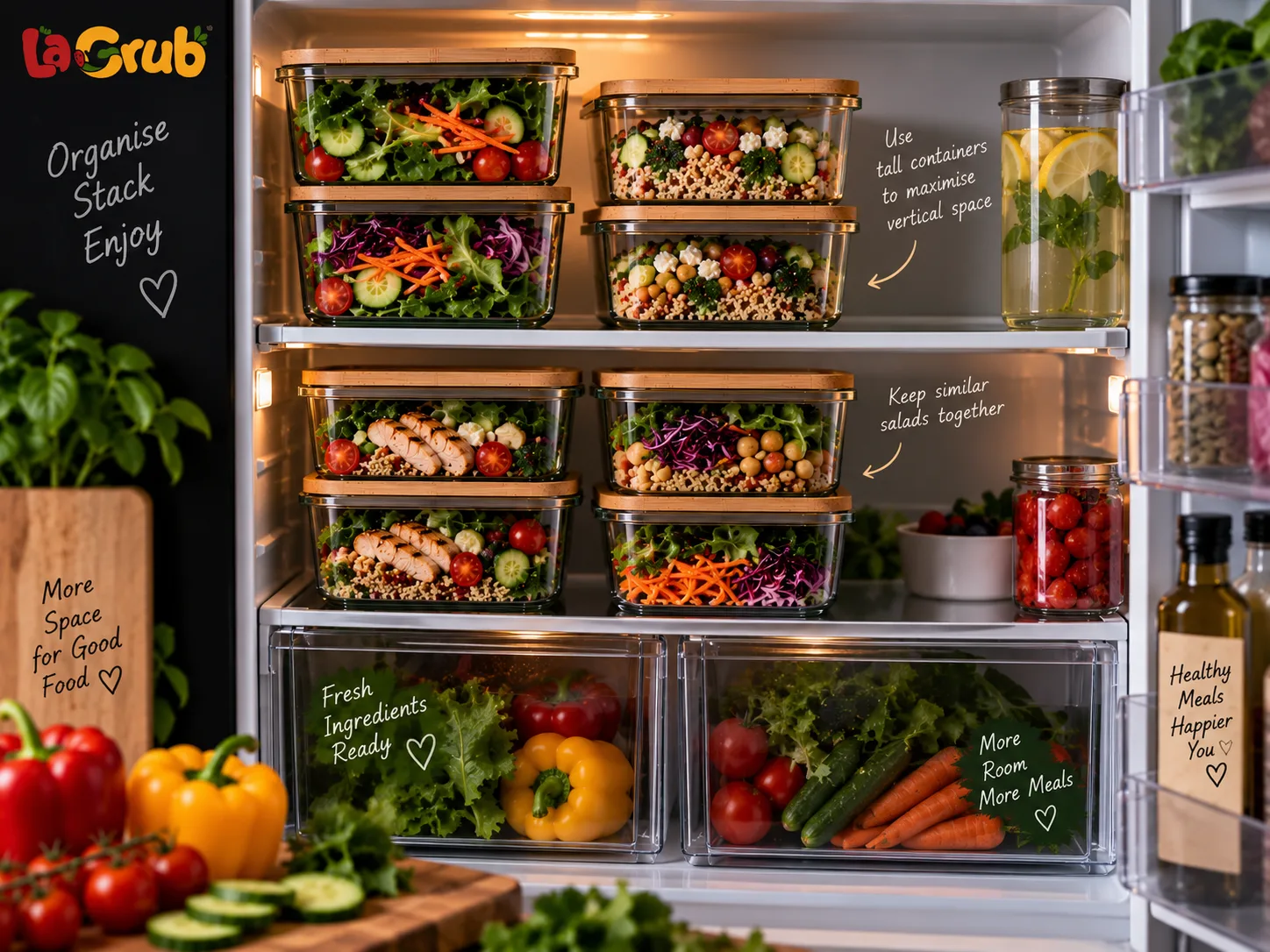
Five large salad containers can take up a surprising amount of refrigerator space.
If storage is limited, ingredient preparation may be more practical.
Keep one container of clean, dry greens, another of firm chopped vegetables, and smaller containers for toppings and dressings.
You can then build each salad when needed.
Stackable containers can also help.
Another option is preparing two or three complete salads and keeping the remaining ingredients ready for later assembly.
There is no requirement that meal prep must mean lining up seven identical containers.
The best system is the one that saves you time without taking over your refrigerator.
FAQs
How Do You Meal Prep Salads Without Getting Soggy?
Start with thoroughly dried greens and keep wet ingredients away from them. Store dressing separately, manage moisture from tomatoes and cucumbers, and add crunchy toppings just before eating. Layering ingredients correctly can also help protect delicate lettuce.
How Long Do Meal-Prepped Salads Last in the Fridge?
It depends on the ingredients. Dry greens and firm vegetables may keep their quality differently from salads containing cooked meat, eggs, cheese, dressing, or juicy vegetables. Always consider the storage requirements of the most perishable ingredients in your salad.
Can You Meal Prep Salads for 5 Days?
You can prepare salad components for a five-day working week, but storing every ingredient together for all five days may reduce freshness. Preparing greens, vegetables, dressing, protein, and toppings separately can give you better control over texture and storage.
Should You Put Dressing on Salad When Meal Prepping?
Usually, it is better to keep dressing separate until you are ready to eat. For properly layered mason jar salads, dressing can be placed at the bottom with sturdy ingredients creating a barrier between it and the greens.
What Is the Best Way to Store Lettuce for Meal Prep?
Wash the lettuce, dry it thoroughly, and place it in a clean container. Keeping excess moisture under control is essential. A dry paper towel can also help absorb small amounts of condensation during storage.
Conclusion
Learning how to meal prep salads is mainly about controlling moisture and storing each ingredient in a way that protects its texture.
Wash and thoroughly dry your greens, keep dressing away from lettuce, separate watery vegetables when needed, protect crunchy toppings, and consider the storage needs of cooked proteins.
You also do not have to eat the same salad every day. Preparing flexible ingredients allows you to create several combinations from one meal-prep session.
Whether you choose individual containers, mason jars, or separate ingredients, build a routine that works with your schedule and fridge space.
Ready to make your weekly meals easier? Explore LaGrub for more meal-prep and cooking guides and discover more practical ways to prepare delicious food ahead of time.

Maimoona Ehtisham
Maimoona Ehtisham writes for LaGrub on cooking, recipes, and mindful culinary living.
Get a desi recipe worth cooking, every week
One tested recipe a week. Nothing else, and unsubscribe any time.


