

South Asian pantry staples for beginners include basmati rice, atta, lentils, chickpeas, ghee, yogurt, onions, garlic, ginger, and everyday spices. With these simple ingredients, you can start cooking easy Desi meals without buying everything at once.
South Asian Pantry Staples for Beginners: 2026 Guide
South Asian pantry staples for beginners are the basic grains, lentils, spices, oils, and fresh items that help you cook Desi meals. Start with rice, atta, 4 lentils, 7 daily spices, onions, tomatoes, ginger, garlic, green chilies, cilantro, yogurt, and ghee.
With those ingredients, you can cook daal, curry, sabzi, roti, pulao, khichdi, and simple snacks. A focused pantry saves money, reduces waste, and makes South Asian cooking feel manageable.
Use South Asian pantry staples for beginners as a working shelf list, not a collector list. A smaller list helps you cook more often.
What Are South Asian Pantry Staples for Beginners?
South Asian pantry staples for beginners are ingredients that appear in daily Pakistani, Indian, Bangladeshi, Sri Lankan, and Nepali home cooking. These staples support rice dishes, lentil dishes, curries, breads, chutneys, and tea.
A beginner pantry does not need 60 spices or 10 types of rice. A beginner pantry needs a reliable base that handles 14 days of home meals.
South Asian pantry staples for beginners should support daily cooking first. Specialty items can wait until you choose specific dishes.
Think in 5 groups: grains, lentils, spices, aromatics, and cooking fats. These groups cover weekday daal, chicken curry, vegetable sabzi, rice, roti, and chai.
LaGrub explains the flavor gap between Desi meals and milder Western meals in its Desi cooking guide. That guide shows why spices, herbs, and aromatics shape South Asian food.
Which 15 South Asian Pantry Staples Should Beginners Buy First?
 South Asian Pantry Staples Should Beginners Buy First?
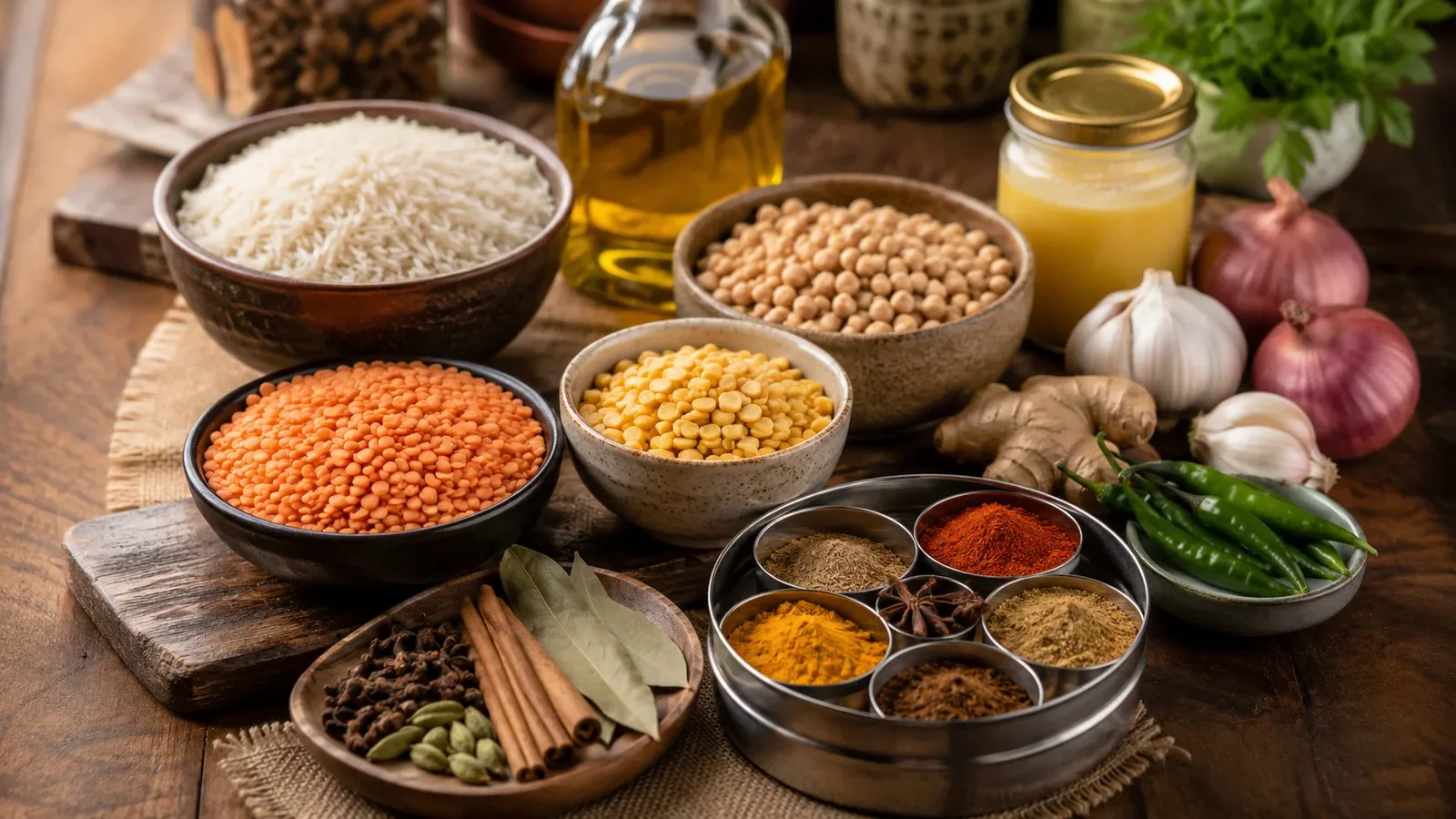
Buy 15 starter items first: basmati rice, atta, masoor dal, moong dal, chana dal, chickpeas, oil, ghee, salt, cumin, coriander, turmeric, red chili, garam masala, and tea. These South Asian pantry staples for beginners cover daily meals before specialty shopping starts.
Start with smaller packs. Buy 2 lb (900 g) rice, 2 lb (900 g) atta, and 1 lb (450 g) each lentil. Use 4 oz (115 g) spice packs because ground spices lose aroma faster than whole spices.
South Asian pantry staples for beginners work best when each item has 3 uses. Rice, lentils, and spices meet that rule easily.
Rice, Atta, and Everyday Grains
Basmati rice gives biryani, pulao, daal chawal, khichdi, and plain rice a long-grain texture. Buy 2 lb (900 g) rice for 6 to 8 meals.
Atta flour makes roti, paratha, and chapati. Buy 2 lb (900 g) atta first, then increase to 5 lb (2.3 kg) after regular cooking begins.
Add semolina, poha, and rice flour later. Semolina supports halwa, poha supports breakfast, and rice flour supports pakoras and crepes.
Lentils, Beans, and Chickpeas
Lentils create fast, affordable protein. Begin with masoor dal, moong dal, chana dal, and urad dal. Each lentil cooks differently and gives different texture.
Masoor dal cooks fast in 20 minutes. Moong dal feels light. Chana dal holds shape. Urad dal gives creamy texture to maash ki daal.
Chickpeas support chana masala, chaat, hummus-style dips, and quick salads. Keep 2 cans, each 15 oz (425 g), or 1 lb (450 g) dried chickpeas.
Cooking Fat, Dairy, and Shelf Basics
Cooking oil handles daily onions, tomatoes, and spice bases. Buy 1 liter (34 fl oz) neutral oil, such as canola or sunflower oil.
Ghee adds aroma to rice, daal, paratha, halwa, and tarka. Buy 8 oz (225 g) ghee because a small spoon changes flavor.
Plain yogurt supports marinades, raita, kadhi, and cooling sides. Keep 16 oz (450 g) yogurt in the fridge for weekly cooking.
What Spices Should South Asian Pantry Staples for Beginners Include?
South Asian pantry staples for beginners should include 7 daily spices, 6 whole spices, and 4 flavor finishers. This mix gives heat, color, aroma, warmth, tang, and freshness.
Buy fresh spices from stores with quick stock turnover. Keep ground spices in airtight jars away from heat, steam, and sunlight.
A spice-first shelf makes South Asian pantry staples for beginners feel useful within the first week. You taste results quickly.
7 Daily Ground Spices and Seeds
Start with salt, turmeric, red chili powder, coriander powder, cumin seeds, cumin powder, and garam masala. These 7 items season daal, sabzi, chicken curry, qeema, and potatoes.
Turmeric gives color and earthiness. Red chili adds heat. Coriander softens sharp flavors. Cumin brings warmth. Garam masala finishes dishes.
Keep 4 oz (115 g) packs for turmeric, chili, coriander, and cumin. Keep 2 oz (55 g) garam masala because garam masala tastes strongest when fresh.
6 Whole Spices for Rice and Curries
Add bay leaves, cinnamon sticks, cloves, green cardamom, black cardamom, and black peppercorns. These 6 whole spices improve pulao, biryani, korma, chai, and meat curries.
Whole spices release aroma slowly. Add whole spices to hot oil, ghee, boiling rice water, or tea. Remove large spices before serving children.
Store whole spices in 8 oz (240 ml) glass jars. Label each jar with the purchase month and year.
4 Flavor Finishers for Fresh Taste
Use kasuri methi, chaat masala, tamarind, and dried red chilies as finishers. These 4 items make basic food taste brighter.
Kasuri methi finishes butter chicken, karahi, and aloo. Chaat masala seasons fruit chaat, fries, chickpeas, and raita.
Tamarind gives sour flavor to chutney, chana, and lentils. Dried red chilies add smoky heat during tarka.
How to Build a South Asian Pantry From Scratch
 South Asian Pantry From Scratch
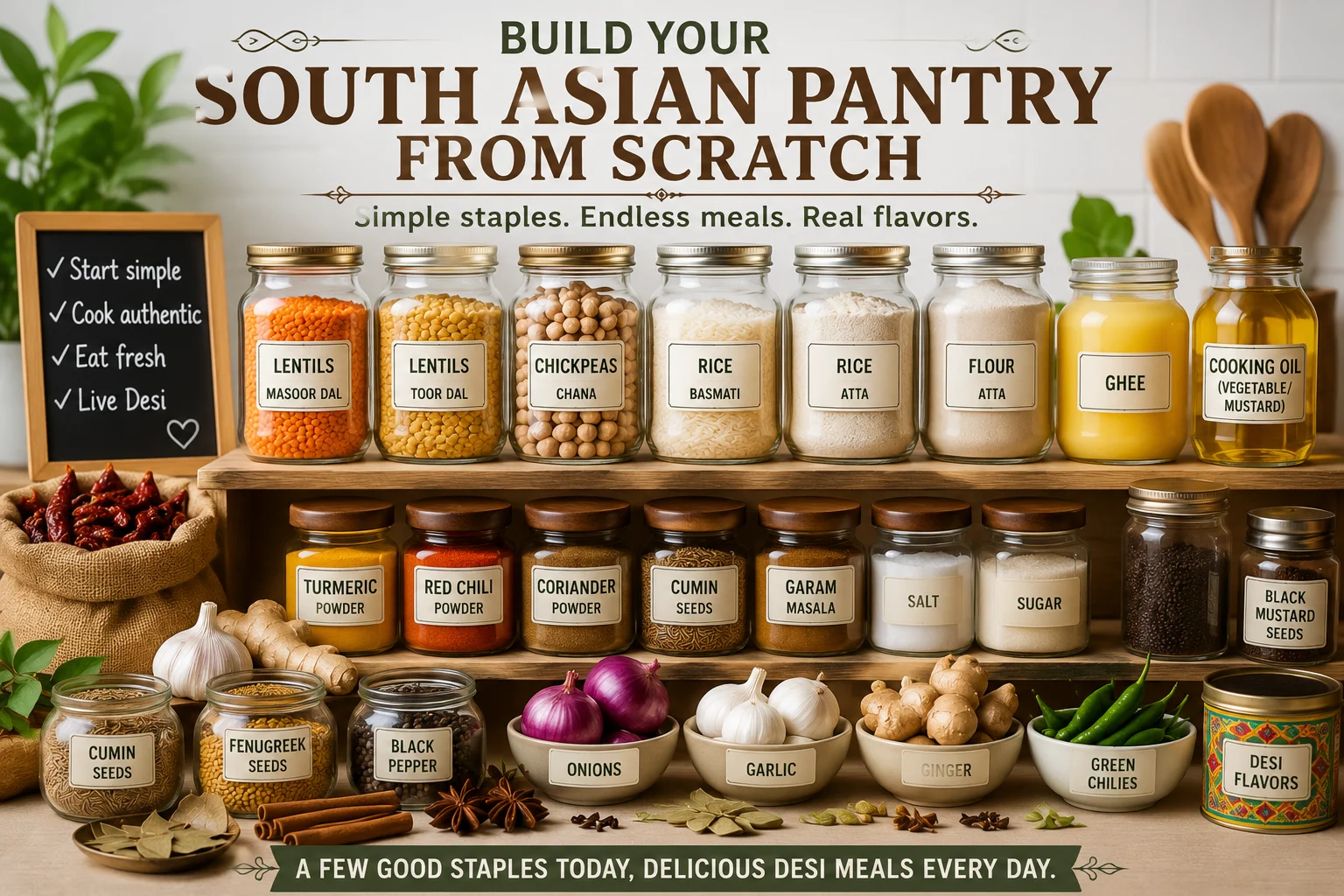
To build a South Asian pantry from scratch, buy weekly basics first, add dish-specific items second, and organize storage third. This order protects your budget and keeps the pantry useful.
Do not buy every colorful packet at the grocery store. A full cart can create clutter before cooking confidence grows.
South Asian pantry staples for beginners should grow through practice. Add new ingredients after you cook 3 meals.
Stage 1: Buy the Weekly Basics
Buy rice, atta, lentils, oil, salt, 7 daily spices, onions, tomatoes, garlic, ginger, and green chilies. These items cook 10 beginner meals.
Use a 14-day test period. Cook daal twice, vegetable curry twice, rice twice, roti twice, and chicken curry once.
Track what you finish. Rebuy only the items you used during the 14-day test period.
Stage 2: Add Dish-Specific Staples
Add dish-specific staples after you choose 3 target recipes. Choose beginner recipes like chicken curry, chana masala, and aloo paratha.
Buy besan for pakoras, tamarind for chutney, and cardamom for chai after weekly cooking feels smooth.
Use ready spice mixes for biryani, nihari, haleem, and seekh kebab during early practice. Replace mixes with whole spices later.
Stage 3: Label and Rotate Everything
Label every jar with the ingredient name and purchase date. Use 2-inch (5 cm) labels or masking tape.
Place daily spices at eye level. Put rice, flour, and lentils on a lower shelf that can hold heavier bags.
Keep a 24-inch (61 cm) shelf for grains and lentils. Keep a 12-inch (30 cm) shelf for spices and small jars.
What Fresh Ingredients Should You Keep With Pantry Staples?
Keep onions, tomatoes, ginger, garlic, green chilies, cilantro, mint, potatoes, lemons, and yogurt with South Asian pantry staples for beginners. These fresh items activate dry pantry ingredients.
Dry spices need fresh partners. Onion, tomato, ginger, garlic, and chili build the curry base called masala.
South Asian pantry staples for beginners become complete when fresh produce joins the dry shelf. Fresh items give aroma and texture.
Aromatics for Curry Bases
Use onions, ginger, garlic, and green chilies as the main aromatics. These ingredients start chicken curry, daal tarka, karahi, qeema, and sabzi.
Buy 2 lb (900 g) onions, 1 lb (450 g) tomatoes, 4 oz (115 g) ginger, and 2 garlic bulbs each week.
Freeze ginger garlic paste in 1 tablespoon (15 ml) portions. Frozen portions help you cook faster on busy days.
Herbs for Freshness
Cilantro and mint finish rice, raita, chutney, chaat, and curry. Fresh herbs balance oil, chili, and warm spices.
Wrap herbs in a dry paper towel and store herbs in a 1-quart (950 ml) container. Replace wet towels after 2 days.
Use cilantro stems in chutney and curry bases. Use mint leaves in raita, biryani, lemonade, and chutney.
Produce for Everyday Meals
Keep potatoes, cauliflower, spinach, okra, peas, and eggplant for vegetable meals. These vegetables work with cumin, turmeric, chili, and coriander.
Buy 2 lb (900 g) potatoes because potatoes stretch meals and support aloo sabzi, aloo gosht, and aloo paratha.
LaGrub covers home cooking value in its Desi food costs guide. That guide fits beginners who want flavorful meals without restaurant spending.
How to Store South Asian Pantry Staples Correctly
To store South Asian pantry staples correctly, keep dry items airtight, keep spices dark, keep flour sealed, and keep herbs dry. Correct storage protects flavor and reduces waste.
Use clear containers for lentils, beans, rice, and flour. Use smaller opaque jars for spices because light weakens color and aroma.
Good storage makes South Asian pantry staples for beginners last longer. The goal is fresh flavor, not full cabinets.
| Task | Timing | Method | Difficulty |
|---|---|---|---|
| Store ground spices | Same day after shopping | Move 4 oz (115 g) packs into airtight jars | Easy |
| Freeze ginger garlic paste | 15 minutes | Pack 1 tablespoon (15 ml) portions in a freezer tray | Easy |
| Sort lentils | 20 minutes | Move 1 lb (450 g) packs into labeled containers | Easy |
| Wash herbs | 10 minutes | Dry cilantro and mint before storage | Medium |
| Rotate pantry | 1 time each month | Place older jars at the front | Easy |
| Check freshness | Every 3 months | Smell spices and discard flat powder | Easy |
Keep rice and flour away from moisture. A 2-quart (1.9 L) container holds about 2 lb (900 g) rice or lentils.
Keep salt, tea, sugar, and spice mixes away from the stove. Steam from cooking weakens texture and freshness.
What Can You Cook With a Beginner South Asian Pantry?
You can cook 10 beginner dishes with a focused South Asian pantry: daal, daal chawal, aloo sabzi, chana masala, roti, paratha, pulao, khichdi, raita, and masala chai. These dishes teach core skills.
Daal teaches boiling, seasoning, and tarka. Sabzi teaches onion-tomato masala. Roti teaches dough texture. Pulao teaches rice timing.
South Asian pantry staples for beginners also teach rhythm. You learn when to fry onions, simmer lentils, and finish with herbs.
Use one pantry to cook across regions. Pakistani kitchens use daal, roti, rice, karahi, and chai. Indian kitchens use dal, sabzi, dosa, pulao, and chutney. Bangladeshi kitchens use rice, lentils, fish, mustard oil, and green chilies.
South Asian diaspora families often search for basmati rice, halal meat, green chilies, cilantro, and atta abroad. LaGrub describes that ingredient search in its Pakistani diaspora food story.
What Mistakes Should Beginners Avoid When Stocking a South Asian Pantry?
Avoid 5 mistakes: buying too many spices, ignoring storage, skipping lentils, buying huge flour bags, and copying advanced recipes too early. These mistakes waste money and space.
A beginner spice shelf should not look like a restaurant store room. Use 13 spices first, then expand after 30 days of cooking.
South Asian pantry staples for beginners lose value when the shelf becomes crowded. Keep the first shelf simple and visible.
Do not buy 10 lb (4.5 kg) atta before you make roti weekly. Flour loses freshness faster in warm kitchens.
Do not skip lentils because meat dishes look more exciting. Lentils teach South Asian seasoning faster than heavy curries.
Do not store spices above the stove. Heat and steam reduce aroma. Place spices 3 feet (0.9 m) away from direct heat.
How to Shop for South Asian Pantry Staples for Beginners on a Budget
To shop for South Asian pantry staples for beginners on a budget, buy small spices, bulk grains, seasonal produce, and 4 lentils. Spend more on rice quality and less on rare specialty packets.
Visit a South Asian grocery store with a written list. Buy only the 15 starter items during the first trip.
South Asian pantry staples for beginners should match your cooking time, family size, and storage space. Buy less during month 1.
Choose store brands for lentils, flour, salt, tea, and chickpeas. Choose trusted brands for basmati rice, ghee, and spice mixes.
Buy 1 new specialty item each week. Add tamarind during week 2, besan during week 3, and kasuri methi during week 4.
Use frozen vegetables when fresh produce costs more. Frozen peas, spinach, okra, and mixed vegetables work well in curry and rice dishes.
Share large spice packs with a friend or family member. A 14 oz (400 g) chili pack loses flavor before one beginner finishes it.
FAQs About South Asian Pantry Staples for Beginners
Are South Asian pantry staples for beginners expensive?
No. A beginner pantry can stay affordable because rice, lentils, flour, spices, and onions create many meals.
Can I cook South Asian food without a masala dabba?
Yes. You can use small jars, tins, or containers before buying a masala dabba. Labels matter more than the box.
Should beginners buy whole spices or ground spices first?
Buy both in small amounts. Ground spices season daily curries, and whole spices improve rice, chai, and meat dishes.
Can I use canned chickpeas instead of dried chickpeas?
Yes. Canned chickpeas save time and work well for chana masala, chaat, salads, and quick curries.
Do I need curry powder for South Asian cooking?
No. Many South Asian cooks use cumin, coriander, turmeric, chili, and garam masala instead of generic curry powder.
Final Takeaway: Build a Pantry You Will Actually Use
South Asian pantry staples for beginners should make cooking easier, not crowded or confusing. Start with 15 starter items, cook 10 simple meals, and add specialty ingredients slowly.
A useful pantry grows from your cooking habits. Rice, atta, lentils, spices, onions, tomatoes, herbs, yogurt, and ghee can carry your first month of Desi cooking.
South Asian pantry staples for beginners give you a calm start. Cook small, repeat meals, and let confidence guide every new purchase.
Explore LaGrub’s recipe collection when you feel ready to turn your pantry into rice dishes, curries, snacks, desserts, and comforting everyday meals.

Sahar Syed
Sahar Syed writes for LaGrub on cooking, recipes, and mindful culinary living.
Get a desi recipe worth cooking, every week
One tested recipe a week. Nothing else, and unsubscribe any time.


