

Wondering how to eat Pakistani food when your table is filled with naan, roti, rice, curry, raita, chutney, and achar? It is easier than it looks. Pair breads or rice with the right dishes, use accompaniments for extra flavour, and enjoy the meal with your hands or cutlery depending on the food and setting.
Wondering how to eat Pakistani food when there is naan, rice, curry, raita, chutney, and several dishes on the table? It is easier than it looks. Match breads or rice with the main dish, add accompaniments for contrast, and eat with your hands or cutlery depending on the food and setting.
How to Eat Pakistani Food
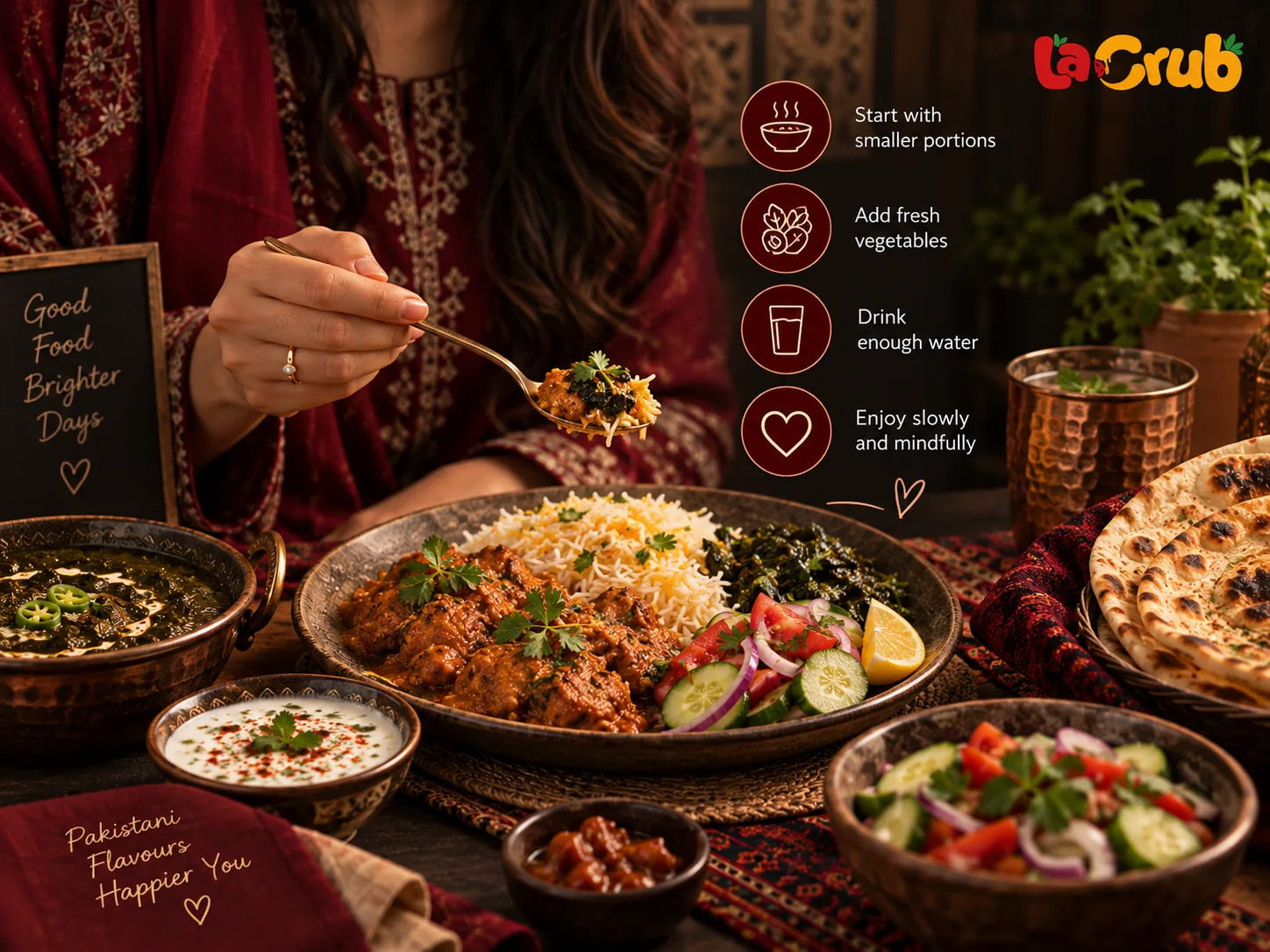
There is no single rule for how to eat Pakistani food because Pakistani cuisine includes many types of meals.
Some dishes are naturally eaten with roti or naan. Others already contain rice. Kebabs may be eaten alone, with bread, or alongside chutney. Daal can be paired with rice or roti depending on the household and style.
The easiest approach is to understand what is on your plate.
For a salan or curry, bread is often used to scoop up the gravy and pieces of meat or vegetables. Rice dishes such as biryani and pulao are usually eaten with a spoon or by hand and served with sides such as raita or salad.
There is also no need to mix every chutney, pickle, sauce, and side into your food.
Start with the main dish. Then use the accompaniments to add freshness, cooling creaminess, heat, acidity, or crunch.
Most importantly, Pakistani dining should feel enjoyable rather than complicated.
What Does a Traditional Pakistani Meal Look Like?
A traditional Pakistani meal can be surprisingly simple.
The huge spread you see at a wedding or restaurant is not how every family eats every day.
A normal home meal may include one salan or vegetable dish with roti. Another day it could be daal chawal. Qeema with roti, chicken salan, aloo dishes, chana, pulao, khichdi, and seasonal vegetables are also familiar home foods.
Meals can become more elaborate when guests arrive.
A dawat may include rice, meat curries, kebabs, breads, raita, salad, chutneys, and dessert.
Pakistan's regional diversity also changes what appears on the table. Punjabi, Sindhi, Pashtun, Balochi, Kashmiri, and urban food traditions do not all follow one menu.
That is why learning how Pakistanis eat is more useful than memorising a fixed meal.
Do Pakistanis Eat With Their Hands?
Yes, eating with the hands is common in Pakistan, but Pakistanis also use spoons, forks, and other cutlery.
It depends on the food and situation.
Roti, naan, paratha, kebabs, and many meat dishes are naturally easy to eat with the hand. You tear off a small piece of bread and use it to pick up the food.
Some people also eat rice by hand, while others prefer a spoon.
At restaurants, weddings, offices, and formal events, cutlery is completely normal.
Therefore, you do not have to eat everything with your fingers to experience authentic Pakistani food.
If you are trying Pakistani cuisine for the first time, use whichever method feels comfortable while following the general etiquette of the setting.
Which Hand Should You Eat With?
When food is eaten directly with the hands, the right hand is traditionally used.
This is particularly relevant when sharing a meal with a Pakistani Muslim family or eating in a traditional setting.
Wash your hands before the meal and use your right hand to handle bread or food.
You do not need to master a complicated technique.
For bread, simply tear off a small piece and use it to pick up the main dish. If a spoon makes a saucy dish easier to manage, use one.
Good table manners matter more than trying to perform every action perfectly.
Roti vs Naan vs Rice: What Should You Eat With Each Dish?
Understanding the difference between roti, naan, and rice makes Pakistani meals much easier.
Roti or chapati is a common everyday bread. It works particularly well with daal, sabzi, chicken salan, qeema, and many home-cooked curries.
Naan is thicker and is often associated with tandoor cooking. It pairs beautifully with richer dishes such as nihari, qorma, karahi, and kebabs.
Rice may be a main dish itself, as with biryani and pulao. Plain rice can also accompany daal or certain curries.
A simple starting guide is:
Roti or chapati: salan, sabzi, qeema, daal, and everyday curries
Naan: nihari, karahi, qorma, kebabs, and richer meat dishes
Rice: biryani, pulao, daal chawal, and selected curries
Paratha: breakfast dishes, eggs, yoghurt, achar, and some kebabs
Either bread or rice: many curries can work with both, depending on preference
These are not strict laws. Pakistani households have their own combinations, and personal preference matters.
How to Eat Pakistani Curry With Roti or Naan
If you have never eaten Pakistani curry with naan, the process is simple.
Place the naan or roti within easy reach. Tear off a small piece using your fingers. Fold or curve it slightly so it can hold a little food.
Use that piece to scoop up some gravy, meat, daal, or vegetables.
Then eat the bread and filling together.
You do not need to soak a huge piece of bread in the curry.
How to Tear Roti or Naan
Try to tear off a piece that is small enough for one bite.
Roti is thin and flexible, so it can easily be folded around a piece of meat or vegetable.
Naan is thicker. A smaller piece is usually easier to handle, especially with a rich gravy.
How to Scoop Salan
Pakistani salan can range from thick masala to a thinner gravy.
Use the bread almost like a small scoop. Pick up some solid food with enough gravy to flavour the bite.
For bone-in chicken or meat, using your fingers may be easier in a casual setting. A spoon can also help you manage extra gravy.
How to Eat Biryani
Biryani needs very little help.
A good Pakistani biryani already combines fragrant rice, meat or chicken, spices, herbs, and masala.
Take a portion that includes both rice and meat. If the biryani contains bone-in chicken or meat, simply separate the edible meat as you go.
Raita is one of the most common partners.
Some people pour a little raita over the rice. Others take small spoonfuls between bites. Salad, sliced onion, lemon, chutney, or achar may also appear alongside it.
There is no requirement to use every accompaniment.
What Should You Serve With Biryani?
Raita is useful because its cool yoghurt base contrasts with hot spices. Fresh salad adds crunch, while lemon adds acidity.
A spicy chutney or achar can make the meal even stronger, so add only a little at first.
Do You Eat Naan With Biryani?
Usually, biryani does not need naan because rice is already the main carbohydrate in the meal.
Some people may enjoy bread alongside it, but it is not necessary.
If you are trying biryani for the first time, start with biryani, raita, and salad. That is more than enough for a satisfying meal.
For another rice dish worth learning, explore LaGrub's How to Cook Basmati Rice Perfectly to understand the fluffy, separate grains that matter in many South Asian meals.
How to Eat Nihari
Nihari is rich, slow-cooked, and made for bread.
A bowl usually contains tender meat surrounded by a deeply flavoured gravy. Depending on how it is served, you may also receive ginger, coriander, green chillies, and lemon.
Naan is an excellent partner.
Tear off a piece and use it to scoop up gravy and meat. Add garnishes according to your taste.
A little lemon can brighten the rich gravy. Ginger adds freshness and bite. Green chilli adds extra heat, so beginners should use it carefully.
You do not have to add every garnish at once.
Taste the nihari first. Then customise it.
How to Eat Pakistani Karahi
Karahi is another dish that works naturally with naan or roti.
Chicken or meat is cooked with a concentrated masala that may include tomatoes, ginger, garlic, chillies, coriander, and other seasonings.
Karahi is often placed in the middle of the table and shared.
Take some onto your plate or use bread to enjoy small portions from your serving.
The thick masala clings beautifully to naan.
Fresh coriander, sliced ginger, green chillies, and lemon may be served as garnishes.
Karahi can range from mild to very hot, so taste it before adding more chilli.
How to Eat Daal Chawal
If you want to understand everyday Pakistani home cooking, try daal chawal.
It is simple, comforting, and widely enjoyed.
Daal is cooked lentils, while chawal means rice.
Place rice on your plate and spoon daal over or beside it. You can mix a small section together so each bite has both rice and lentils.
Some families serve achar, salad, yoghurt, papad, or chutney alongside it.
These extras are optional.
Daal chawal is important because it shows a different side of Pakistani cuisine. Pakistani food is not always a huge plate of meat, oil, and intense spice.
Sometimes a warm bowl of lentils and rice is exactly what people want.
What Are Raita, Chutney and Achar For?
The small dishes beside a Pakistani meal are not random decorations.
They help create contrast.
Raita is yoghurt-based and can contain cucumber, onion, mint, coriander, boondi, cumin, or other seasonings. It is especially popular with biryani, pulao, and spicy foods.
Chutney varies considerably. Mint and coriander chutney can be fresh and spicy, while tamarind-based chutneys may bring sweet and sour flavours.
Achar is Pakistani-style pickle. It can be intensely salty, spicy, sour, and aromatic, so a small amount is usually enough.
You may also receive sliced onions, cucumber, tomato, coriander, or lemon.
Think of these as flavour controls.
Your main dish remains the centre of the meal. Add the sides according to what tastes good to you.
What Pakistani Food Should a Beginner Try First?
You do not need to begin with the hottest curry on the menu.
Choose according to the experience you want:
For rice: try biryani or pulao.
For bread and curry: start with chicken karahi or a mild chicken salan.
For comfort food: choose daal chawal or khichdi.
For grilled meat: try seekh kebab or chapli kebab.
For something rich: order nihari or qorma.
For street food: try bun kebab, samosa chaat, or gol gappay.
For breakfast: try halwa puri, naan chanay, or paratha with eggs.
For something sweet: finish with kheer, gulab jamun, ras malai, or gajar ka halwa.
Trying different categories will teach you much more about Pakistani cuisine than ordering biryani every time.
Is Pakistani Food Always Spicy?
No.
Pakistani food is often heavily spiced, but “spiced” and “hot” do not mean the same thing.
Cumin, coriander, cardamom, cinnamon, cloves, black pepper, turmeric, and garam masala can create strong aromas without making a dish painfully hot.
Chilli creates more obvious heat.
Some biryanis, curries, chutneys, and pickles can be very hot. Other dishes can be mild.
Pulao, some daals, grilled meats, and certain regional foods may rely more on aroma and savoury flavour than chilli.
If you are ordering at a restaurant, asking about the chilli level is completely reasonable.
Do not assume that avoiding extreme heat means you are not experiencing authentic Pakistani cooking.
What Do Pakistanis Actually Eat Every Day?
Everyday Pakistani meals are usually less elaborate than restaurant menus suggest.
A family is unlikely to prepare biryani, nihari, karahi, kebabs, and qorma together on an ordinary Tuesday night.
Instead, home meals often revolve around one main dish with bread or rice.
Common combinations can include:
Daal with rice or roti
Chicken salan with chapati
Qeema with roti
Aloo, bhindi, saag, or mixed sabzi with bread
Chana or lobia with rice or roti
Pulao with raita
Khichdi with yoghurt or achar
What people eat changes by region, season, household, budget, and personal preference.
This everyday side is essential when learning how to eat Pakistani food, because home cooking tells you as much about a cuisine as famous restaurant dishes do.
Pakistani Restaurant Food vs Home Food
Restaurant food often needs to look rich, smell powerful, and make an immediate impression.
Home food serves a different purpose.
It needs to work as everyday nourishment.
That is why Pakistani home cooking may contain simpler daals, vegetables, salans, rice dishes, and rotis rather than restaurant-style feasts every night.
Oil and richness can also differ.
Special dishes still appear at home, particularly when relatives visit or during celebrations.
This difference explains why someone who only eats at Pakistani restaurants may develop a very different picture of the cuisine from someone who regularly eats in Pakistani homes.
To explore that home-style side, LaGrub's How Much Does It Cost to Make Desi Food at Home? gives another look at practical everyday Desi cooking.
How to Eat Pakistani Street Food
Pakistani street food is often less formal.
Samosa chaat may come loaded with chickpeas, yoghurt, chutneys, onions, herbs, and crunchy toppings. Use a spoon to get several elements in each bite.
Gol gappay are more interactive. The crisp shells are filled with chickpeas, potato, chutney, or spiced water depending on the style, then eaten whole.
A bun kebab is easier. Pick it up like a burger.
Pakistani street snacks often combine contrasting flavours: spicy, sour, sweet, salty, creamy, and crunchy.
The best approach is to taste the dish as served before adding extra chutney or chilli.
How to Eat at a Pakistani Family Gathering
A Pakistani family meal can feel generous, especially when you are a guest.
You may see several dishes on the table, and your host may encourage you to take another serving even when your plate is nearly empty.
Basic etiquette keeps things simple:
Wash your hands before sitting down to eat.
Use your right hand when directly handling food.
Start with a sensible portion; you can take more later.
Try different dishes if you want, but you do not have to pile everything together.
Be considerate when food is being shared.
Compliment dishes you genuinely enjoy.
Follow the host's lead if you are unsure about serving.
Do not worry if you prefer cutlery.
Pakistani hospitality often expresses itself through food, so being offered more can simply be part of the experience.
What Do Pakistanis Eat for Breakfast?
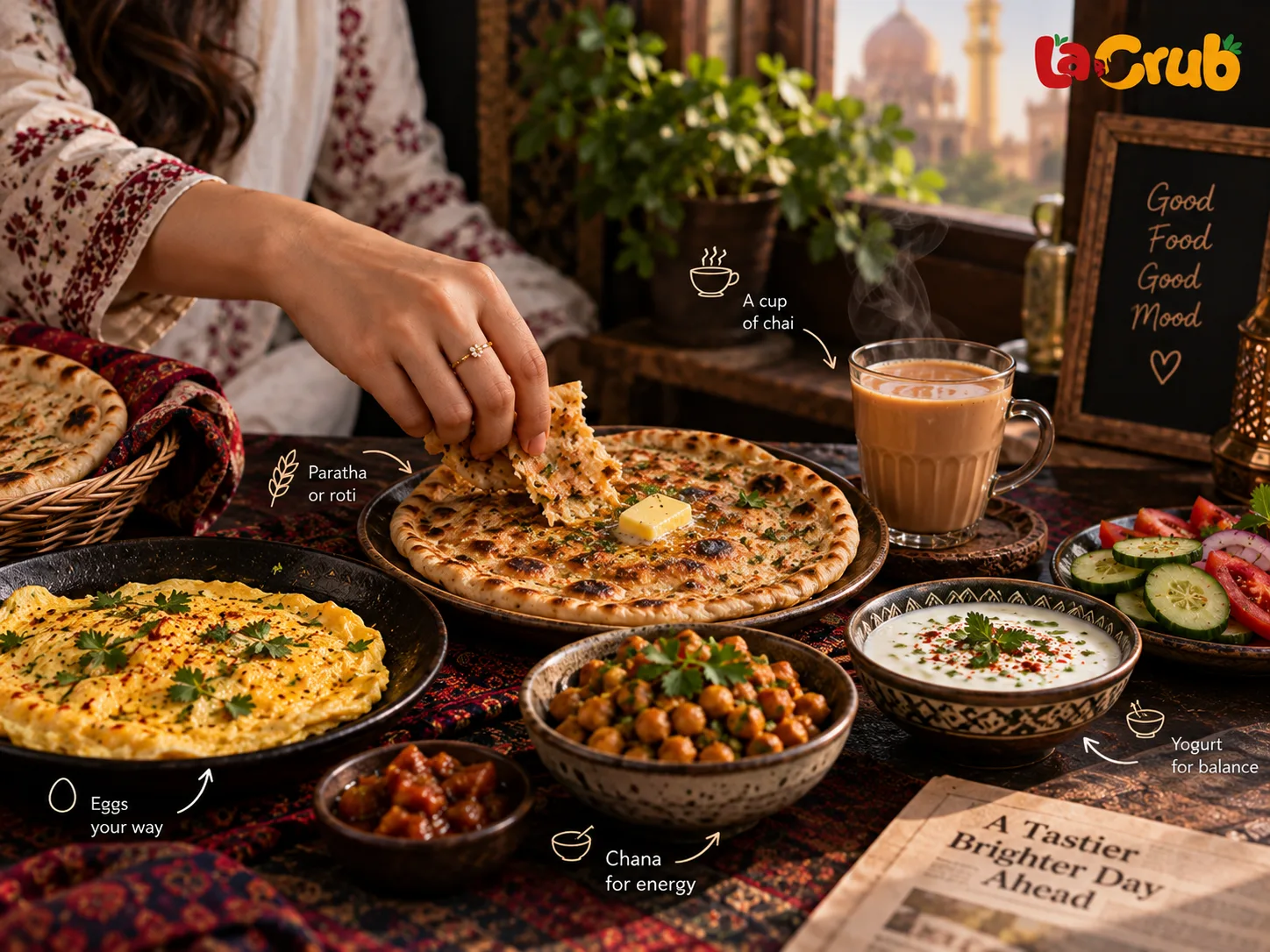
Pakistani breakfast ranges from very simple to extremely filling.
On an ordinary day, someone may eat paratha with egg, roti, yoghurt, chai, toast, or another quick breakfast.
Weekend and restaurant breakfasts can become much bigger.
Halwa puri is a famous example. Puri is paired with chickpea curry and sweet halwa. A little of each creates a sweet, savoury, and spicy contrast.
Naan chanay is another popular option.
Nihari can also appear as a hearty breakfast, particularly in cities with strong nihari traditions.
Paratha works well with eggs, yoghurt, achar, or chai.
Breakfast therefore follows the same basic principle as the rest of Pakistani dining: combine foods that balance each other rather than searching for one rigid eating rule.
What Comes After a Pakistani Meal?
Not every meal ends with dessert.
After an ordinary home dinner, people may simply have water, tea, or nothing else.
At a dawat, wedding, Eid celebration, or special family meal, sweets are more likely.
Kheer, gulab jamun, ras malai, sheer khurma, and gajar ka halwa are familiar choices.
Chai can also appear after the meal, particularly when people remain together to talk.
If you want to try a traditional dessert at home, LaGrub's How to Make Gajar Ka Halwa walks through one of South Asia's best-loved sweet dishes.
For a wider range of cooking inspiration, you can also explore LaGrub's cookbook collection for regional recipes and food traditions from Pakistan and beyond.
FAQs
Do Pakistanis Eat With Their Hands?
Yes, many Pakistanis eat certain foods with their hands, especially roti, naan, paratha, kebabs, and traditional meals. Rice may also be eaten by hand. However, spoons and forks are widely used, so using cutlery is completely acceptable.
What Should I Order at a Pakistani Restaurant for the First Time?
A good first meal could include chicken karahi with naan, biryani with raita, seekh kebabs, or a mild pulao. If you prefer something simple, daal with rice or roti is a great introduction to Pakistani home-style food.
Do You Eat Pakistani Curry With Rice or Naan?
Both can work. Salan, karahi, nihari, and qorma are often eaten with naan or roti, while daal and some curries pair well with rice. The best accompaniment depends on the dish and your preference.
What Do You Eat With Pakistani Biryani?
Biryani is commonly served with raita and fresh salad. Chutney, achar, onion, or lemon may also be offered. Because biryani already contains rice, naan is usually unnecessary.
Is Pakistani Food Always Spicy?
No. Pakistani food uses many spices, but not every dish contains intense chilli heat. Pulao, daal, grilled meats, and many home-cooked foods can be mild. If you are sensitive to chilli, ask about the heat level before ordering.
Conclusion
Learning how to eat Pakistani food is much easier once you stop looking for strict rules.
Start with the main dish.
Use roti or naan to scoop salan, karahi, nihari, daal, or vegetables. Enjoy biryani and pulao as rice-based meals. Add raita when you want something cool, chutney when you want freshness or tang, and a small amount of achar when you want a strong salty and sour kick.
You can eat with your right hand where appropriate, but there is nothing wrong with using a spoon or fork.
More importantly, do not judge Pakistani cuisine only by restaurant favourites.
Biryani, nihari, and karahi are wonderful, but so are daal chawal, chicken salan, qeema, sabzi, khichdi, pulao, roti, and the simple meals Pakistani families enjoy every day.
Try breakfast. Explore street food. Taste regional dishes. Learn what the little bowls of chutney and raita are doing beside your plate.
Pakistani food is at its best when you explore it rather than worry about eating it perfectly.
Visit LaGrub to discover more authentic Pakistani food guides, Desi recipes, regional dishes, and cookbooks, and start building your own understanding of the flavours and traditions behind every meal.

Maimoona Ehtisham
Maimoona Ehtisham writes for LaGrub on cooking, recipes, and mindful culinary living.
Get a desi recipe worth cooking, every week
One tested recipe a week. Nothing else, and unsubscribe any time.


