

Wondering is Pakistani food Mediterranean? Pakistani cuisine is actually South Asian, not Mediterranean. Still, the confusion makes sense. Pakistani food shares ingredients such as yoghurt, rice, grilled meat, legumes, herbs, and flatbreads with cuisines further west, while Persian, Afghan, and Central Asian influences have also helped shape its distinctive food culture
Is Pakistani food Mediterranean? No. Pakistani food is primarily South Asian cuisine, not Mediterranean cuisine. However, some similarities can make the distinction confusing. Pakistani cooking shares ingredients such as yoghurt, grilled meat, rice, legumes, flatbreads, and herbs with cuisines further west, while Persian, Afghan, and Central Asian influences add another layer.
Is Pakistani Food Mediterranean?
Pakistani food is not generally classified as Mediterranean food.
Pakistan is part of South Asia, and its food reflects the country's geography, regional cultures, history, agriculture, migration, and connections with neighbouring areas.
Still, the confusion makes sense.
Walk into a Pakistani restaurant and you may find grilled kebabs, lamb, yoghurt, rice, chickpeas, lentils, flatbreads, fresh herbs, and meat cooked over fire. Many of those foods or ingredients also appear around the Mediterranean and Middle East.
However, sharing ingredients does not make two cuisines the same.
Pakistani cooking has its own flavour-building methods. Onions, tomatoes, ginger, garlic, chillies, cumin, coriander, turmeric, and garam masala frequently form the base of savoury dishes. Techniques such as bhunao, tarka, dum cooking, grilling, and slow cooking also shape the final flavour.
So, while you may notice similarities, Pakistani cuisine has a distinctly South Asian identity.
Is Pakistan a Mediterranean Country?
No. Pakistan is not a Mediterranean country.
Mediterranean countries are connected geographically to the Mediterranean Sea and the wider Mediterranean region.
Pakistan is located in South Asia.
Its neighbours include India, China, Afghanistan, and Iran, while its southern coastline meets the Arabian Sea.
This location is important when understanding Pakistani cuisine.
Pakistan sits at an interesting culinary crossroads. To the east is the rest of the Indian subcontinent. To the west are Iran and Afghanistan. Further historical connections stretch towards Central Asia and beyond.
As a result, Pakistani food can feel familiar to people from several different food cultures.
Yet geographical closeness and historical exchange do not turn Pakistani food into Mediterranean cuisine.
Is Pakistan in the Middle East or South Asia?
Pakistan is generally classified geographically as part of South Asia.
This is another source of confusion around Pakistani food.
Because Pakistan borders Iran and Afghanistan and has strong historical links with Muslim cultures further west, people sometimes casually group it with the Middle East.
However, Pakistan's South Asian identity is central to understanding its food.
Ingredients such as lentils, rice, wheat, chickpeas, vegetables, spices, yoghurt, and meat are used within cooking traditions that developed across the Indian subcontinent and neighbouring regions.
At the same time, geography allowed food ideas to travel.
Persianate court traditions, Central Asian cooking, Afghan food culture, migration, trade, and local South Asian techniques all contributed to what people now recognise as Pakistani cuisine.
That combination is why simple labels often fail to capture the whole story.
What Type of Cuisine Is Pakistani Food?
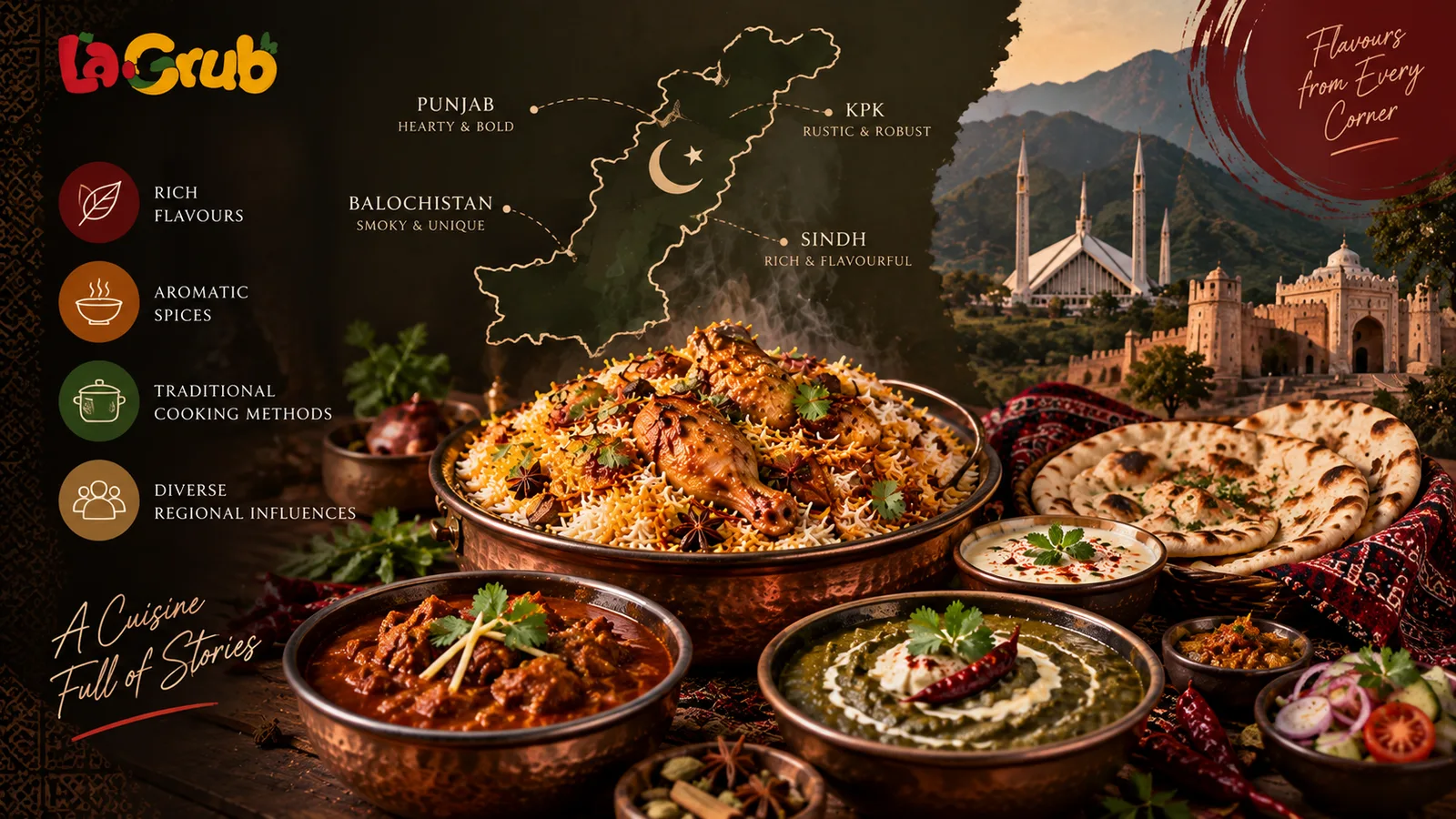
The best broad classification is South Asian cuisine.
However, Pakistani cuisine itself is not one single cooking style.
Pakistan contains several regional food traditions.
Punjabi cooking includes breads, lentils, vegetables, meat curries, tandoor cooking, and hearty seasonal dishes. Sindhi cuisine brings its own rice dishes, curries, spice combinations, and regional specialities.
Pashtun food traditions often highlight meat, grilling, kebabs, pulao, and simpler seasoning that allows the main ingredients to stand out.
Balochi cooking has another identity, with dishes such as sajji strongly connected to the region.
Migration has added further layers to urban Pakistani food.
Therefore, saying Pakistani cuisine is South Asian is correct, but it is only the beginning of the story.
Why Does Pakistani Food Sometimes Seem Middle Eastern?
Certain foods create an immediate visual connection.
Think about kebabs, grilled lamb, flatbreads, yoghurt, rice, chickpeas, and meat cooked over charcoal.
You can encounter versions of these foods across Pakistan, Afghanistan, Iran, Central Asia, Turkey, the Levant, and other regions.
However, similar-looking food can taste completely different.
A Pakistani seekh kebab may contain a seasoning profile that differs greatly from a kebab prepared in another country.
Pakistani naan is also eaten in a different meal context from many Mediterranean flatbreads.
Even yoghurt changes character depending on how it is used. In Pakistan, it may become raita, appear in marinades, contribute to curry bases, or simply be served alongside spicy food.
Therefore, visual similarity does not automatically mean the foods belong to the same cuisine.
Is Pakistani Food Middle Eastern?
Pakistani food is not generally classified as Middle Eastern cuisine either.
However, there are historical connections.
Persianate culture influenced language, art, architecture, court life, and food across parts of South Asia. Muslim dynasties and migration also brought culinary traditions into contact with local ingredients and cooking methods.
Afghanistan provides another connection.
Pashtun communities live across the modern Pakistan-Afghanistan border, so it would be unrealistic to expect food traditions to stop neatly at a political line.
Likewise, Baloch communities and regional histories create connections towards Iran.
The result is not “Middle Eastern food in Pakistan.”
It is Pakistani food shaped by South Asian foundations and centuries of regional exchange.
Mediterranean Food vs Middle Eastern Food
Before comparing Pakistani food with either cuisine, it helps to separate Mediterranean food from Middle Eastern food.
They overlap, but they are not interchangeable labels.
The Mediterranean region includes many different culinary traditions around the Mediterranean Sea. Southern European, North African, Levantine, and other cuisines can all form part of the wider Mediterranean food world.
Middle Eastern cuisine is another broad category covering diverse countries and communities. Some are located in the eastern Mediterranean, while others are not.
This means a dish can be Middle Eastern and Mediterranean, one but not the other, or neither.
Pakistani cuisine falls outside both broad geographic categories.
It belongs primarily to South Asia.
Pakistani Food vs Mediterranean Food
Comparing the cuisines shows both overlap and clear differences.
Ingredients
Both food traditions can use vegetables, legumes, yoghurt, grains, herbs, meat, and nuts.
However, the balance and preparation can be different.
Pakistani cooking commonly uses lentils, basmati rice, atta, chickpeas, onions, tomatoes, yoghurt, chicken, goat, beef, vegetables, ginger, garlic, and chillies.
Mediterranean ingredients vary enormously by country, but olive oil, vegetables, grains, legumes, herbs, seafood, fruit, nuts, and dairy products feature strongly in many regional traditions.
Spices and Flavours
Spice is one of the clearest differences.
Pakistani cooking commonly builds layers with ingredients such as:
Cumin, coriander, turmeric, chilli, black pepper, and garam masala
Ginger, garlic, onions, tomatoes, and green chillies
Cardamom, cinnamon, cloves, bay leaves, and other whole spices
Fresh coriander, mint, lemon, yoghurt, and chutneys
Tamarind, dried mango, or other sour elements depending on the dish
Mediterranean food certainly uses spices too, but many regional styles rely strongly on herbs, olive oil, garlic, citrus, vegetables, and their own local seasoning traditions.
Cooking Methods
Pakistani food often builds flavour in stages.
A cook may brown onions, fry aromatics, add tomatoes and spices, perform bhunao, add meat or vegetables, and then simmer until the flavours come together.
Tarka is another important technique, particularly for lentils.
Dum cooking traps steam and aroma, while tandoor and charcoal cooking create very different textures.
Mediterranean cuisines also grill, roast, stew, fry, and slow cook, but the flavour-building sequence and ingredient combinations often differ.
What Do Pakistani and Mediterranean Foods Have in Common?
Despite their different classifications, there are genuine similarities.
Both food worlds value ingredients that have travelled widely across Asia, Europe, and the Middle East.
Shared elements can include:
Grilled or roasted meats
Lentils, chickpeas, beans, and other legumes
Yoghurt and yoghurt-based dishes
Wheat breads and flatbreads
Rice and grain-based meals
Fresh herbs, onions, tomatoes, and lemon
Nuts and dried fruits in selected dishes
These similarities are not surprising.
Food has travelled for centuries through migration, trade, conquest, religion, marriage, and cultural exchange.
The interesting question is not simply whether two cuisines share chickpeas.
It is what each culture does with them.
Why Are Kebabs, Flatbreads and Yoghurt Found in Both?
Foods do not belong neatly inside modern national borders.
Kebabs are a perfect example.
Different grilled and minced meat traditions appear across a huge area. Pakistan has made several forms deeply its own.
Chapli kebab is strongly connected with Pashtun food culture. Seekh kebabs are widely eaten across Pakistan and are seasoned according to local preferences.
Flatbreads tell a similar story.
Pakistan has naan, roti, chapati, paratha, kulcha, and other breads. Although other cultures also eat flatbreads, the ingredients, cooking methods, and meals surrounding them can differ.
Yoghurt is equally widespread.
In Pakistan, it may become cooling raita beside biryani, help tenderise meat in a marinade, contribute to qorma, or be eaten alongside paratha.
Shared ingredients show historical connections. They do not erase regional identity.
How Persian and Central Asian Food Influenced Pakistan
One reason Pakistani cuisine can sometimes seem closer to food further west is its long history of cultural exchange.
Persianate influence was particularly important in the courts and cities of the Indian subcontinent.
Rice preparations, meat dishes, aromatic spices, dried fruits, nuts, kebabs, and slow-cooked foods all became part of wider culinary exchanges.
Central Asian influences arrived through other routes and communities.
However, imported ideas did not remain unchanged.
Local cooks used ingredients available in South Asia. They adjusted spice levels, cooking techniques, textures, and accompaniments.
Over generations, those adaptations became part of local food culture.
This is why Pakistani cuisine can contain influences from several directions while still remaining distinctly Pakistani.
What Foods Are Uniquely Pakistani?
The word “uniquely” can be difficult when discussing food.
Political borders are relatively recent compared with many recipes. Communities also cross borders, and neighbouring regions naturally share dishes.
Instead of asking whether nobody outside Pakistan has ever eaten something similar, it is more useful to look at foods strongly connected with Pakistani regions and food culture.
Examples include chapli kebab, Sindhi biryani, sajji, Lahori fried fish, bun kebab, namak gosht, and regional preparations found across Punjab, Sindh, Khyber Pakhtunkhwa, and Balochistan.
Pakistan has also developed distinctive ways of preparing foods that may have relatives elsewhere.
That is how cuisine usually works.
Identity comes not only from invention but also from adaptation, regional preference, technique, and cultural meaning.
For another look at the country's food identity, LaGrub's What Is Pakistani Food? guide explores the dishes, flavours, and traditions that shape Pakistani cuisine.
Pakistani Food vs Indian Food
Pakistani and Indian food share much more direct history with each other than Pakistani and Mediterranean cuisine.
Both modern countries emerged from a subcontinent where food traditions had developed for centuries.
That explains shared foods such as biryani, daal, qorma, pulao, kebabs, curries, roti, paratha, and many sweets.
Still, neither national cuisine is one uniform style.
Pakistan contains Punjabi, Sindhi, Pashtun, Balochi, Kashmiri, Muhajir, and other culinary influences.
India contains an enormous range of regional food traditions of its own.
So, shared dishes do not make Pakistani food identical to Indian food, just as kebabs and yoghurt do not make it Mediterranean.
The differences become clearer when you compare specific regions, dishes, ingredients, and cooking techniques instead of using national labels alone.
Why Are Pakistani Restaurants Abroad Sometimes Labelled Indian?
Restaurant labels can reflect marketing as much as culinary geography.
In some countries, customers may already recognise the phrase “Indian food” more quickly than “Pakistani food.”
A Pakistani-owned restaurant may therefore use labels such as Indian and Pakistani cuisine, Indian subcontinental food, or South Asian cuisine to make the menu easier for local customers to understand.
Menus can also mix dishes from several traditions.
A restaurant might serve Pakistani karahi and chapli kebab beside foods that customers associate more strongly with Indian restaurant dining.
This can blur the distinction for someone who has never visited South Asia.
However, restaurant marketing does not change Pakistan's geographic or culinary classification.
What Do Pakistanis Actually Eat Every Day?
Another reason people misunderstand traditional Pakistani food is that restaurant menus focus on dishes that sell well.
Biryani, nihari, karahi, qorma, kebabs, and fried foods are memorable, but they do not represent every Pakistani meal.
Everyday home cooking is often simpler.
A family might eat:
Daal with rice or roti
Chicken salan with chapati
Bhindi, aloo, saag, or another seasonal sabzi
Chana, lobia, or other legumes
Keema with vegetables
Khichdi, pulao, or a simple rice dish
Yoghurt, achar, salad, or chutney alongside the meal
This everyday food shows why judging an entire cuisine by wedding food or restaurant dishes can be misleading.
If you want to explore this home-style side further, LaGrub's One-Pot Desi Meals for Busy Weeknights offers a practical look at easier Desi meals for everyday cooking.
Is Pakistani Food Healthy?
Pakistani food cannot be labelled simply healthy or unhealthy.
It depends on the dish, portion, ingredients, cooking method, and overall eating pattern.
A meal built around daal, vegetables, yoghurt, whole grains where suitable, and moderate portions of protein can provide fibre, protein, vitamins, minerals, and other nutrients.
On the other hand, some celebration foods, restaurant curries, fried snacks, sweets, and heavily refined meals can contain more oil, ghee, salt, sugar, or refined carbohydrates.
The same distinction exists in Mediterranean countries.
A cuisine may contain foods associated with a balanced diet as well as rich desserts, fried dishes, processed foods, and large portions.
Therefore, asking whether Pakistani food or Mediterranean food is healthier is too broad.
The individual meal and overall diet matter much more.
Can Pakistani Food Fit a Mediterranean-Style Diet?
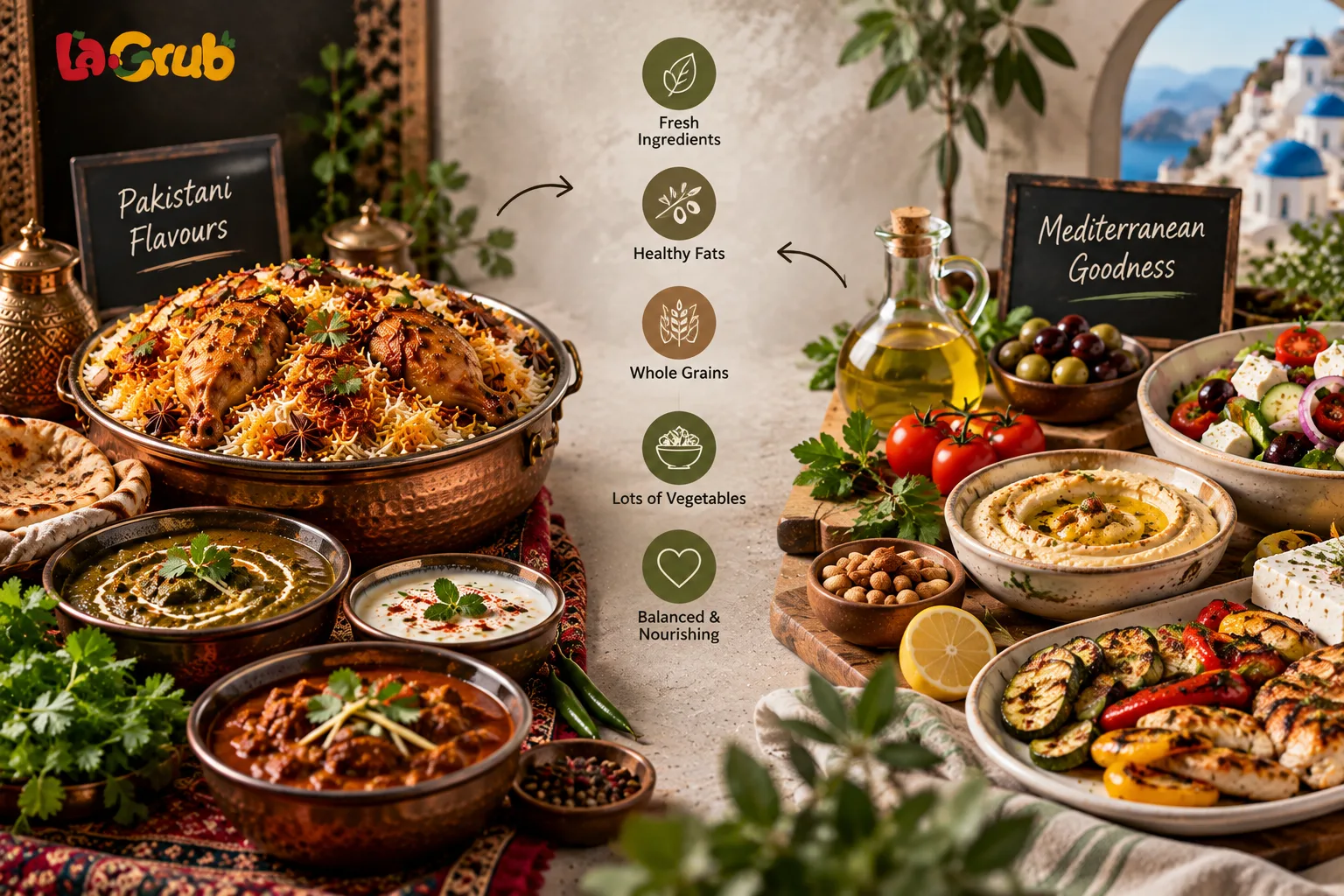
Pakistani food does not have to become Mediterranean to share some features with a Mediterranean-style eating pattern.
The key is choosing suitable dishes and adjusting the overall balance of meals.
Pakistani cuisine already has useful building blocks such as lentils, chickpeas, beans, vegetables, yoghurt, fish, nuts, seeds, herbs, and whole grains where available.
Daal can provide plant protein and fibre. Chana and lobia are useful legumes. Vegetable dishes can bring more variety to the plate.
Grilled fish or chicken can offer an alternative to heavily fried foods.
Cooking fat and portion sizes can also be adjusted according to personal needs.
A practical approach might include:
Making daal, beans, chickpeas, and vegetables regular parts of meals
Choosing grilled, roasted, or lightly cooked proteins more often
Controlling added oil rather than assuming every curry needs a visible layer
Adding salad, yoghurt, herbs, and vegetables to the plate
Treating fried snacks and rich desserts as occasional foods rather than everyday staples
The goal is not to turn daal into hummus or replace roti with pita.
It is to recognise that balanced eating principles can work across different food cultures.
For readers interested in fibre-rich meal ideas, explore LaGrub's High-Fiber & Gut Health Cookbook collection for more inspiration built around satisfying, practical foods.
FAQs
Is Pakistani Cuisine Considered Mediterranean?
No. Pakistani cuisine is generally classified as South Asian cuisine. Pakistan does not border the Mediterranean Sea. However, Pakistani cooking shares some ingredients and historical connections with food traditions further west, which can make certain dishes seem familiar.
Is Pakistani Food Middle Eastern or Asian?
Pakistani food is Asian, more specifically South Asian. Pakistan borders Iran and Afghanistan and has historical Persian, Afghan, and Central Asian culinary influences, but it is not generally classified as a Middle Eastern country or cuisine.
What Cuisine Is Pakistani Food?
Pakistani food is South Asian cuisine with diverse regional traditions. Punjabi, Sindhi, Pashtun, Balochi, Kashmiri, Muhajir, and other communities contribute different foods and cooking styles. Persianate, Afghan, Central Asian, and wider South Asian connections have also influenced its development.
Why Is Pakistani Food Similar to Middle Eastern Food?
The similarities come from a combination of geography, migration, trade, shared ingredients, and centuries of cultural exchange. Kebabs, yoghurt, rice, meat, nuts, and flatbreads appear across many regions, but Pakistani cooks use them within their own spice profiles and cooking traditions.
Is Pakistani Food the Same as Indian Food?
No. Pakistani and Indian cuisines share a long history and many related dishes, but each country has its own regional food cultures and modern culinary identities. Pakistani food also reflects strong Sindhi, Pashtun, Balochi, Punjabi, and other traditions that create considerable variety within the country itself.
Conclusion
So, is Pakistani food Mediterranean?
No. Pakistani food is primarily South Asian cuisine.
Pakistan is not a Mediterranean country, and its food should not be reclassified simply because it contains kebabs, yoghurt, rice, chickpeas, grilled meat, or flatbreads.
However, the similarities are worth understanding.Pakistan's location has connected it with the wider Indian subcontinent, Afghanistan, Iran, and historical routes leading towards Central Asia. Migration, trade, empires, and cultural exchange brought culinary ideas from different directions.Pakistani cooks then adapted those influences to local ingredients and tastes.
The result is a cuisine where biryani can sit beside chapli kebab, daal chawal, sajji, saag, chicken salan, pulao, roti, and countless regional foods.Some dishes may remind you of Middle Eastern cooking. Others share obvious connections with Indian food. Still others are closely tied to specific Pakistani regions.None of these connections makes Pakistani food less distinctive.
Instead of asking whether Pakistani cuisine fits perfectly inside another food category, explore it on its own terms.Try its regional dishes, learn how Pakistani masala is built, compare home cooking with restaurant food, and notice how techniques such as tarka, bhunao, grilling, and dum create different flavours.
Explore LaGrub for more Pakistani food guides, authentic Desi recipes, and curated cookbooks that make it easier to understand the stories, techniques, and flavours behind South Asian cooking.

Maimoona Ehtisham
Maimoona Ehtisham writes for LaGrub on cooking, recipes, and mindful culinary living.
Get a desi recipe worth cooking, every week
One tested recipe a week. Nothing else, and unsubscribe any time.


